
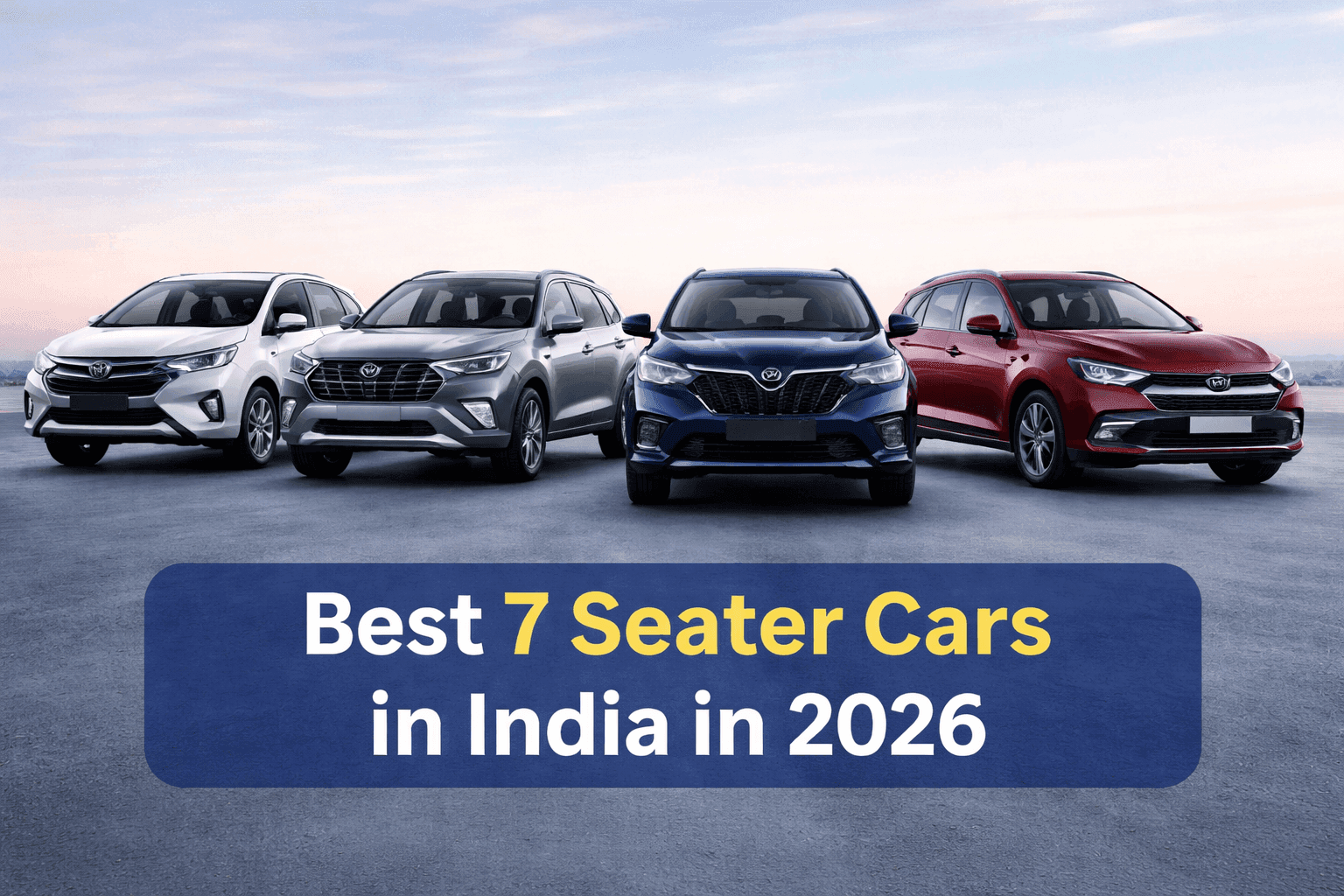
Looking for a 7-seater car that balances comfort, budget, and reliability? Finding the right vehicle for a family that seats seven comfortably across different budgets and preferences can be overwhelming. This guide compares India's 10 best-selling and highest-rated 7-seater cars with verified specifications, real prices, mileage, safety ratings, and insurance considerations to help you choose confidently.
Whether you need a budget-friendly MPV under ₹7 lakh, a feature-rich mid-range option, or a premium SUV with advanced safety technology, you'll find honest comparisons here based on 2026 market data.
Best Budget 7-Seater Cars Under 7 Lakhs
For first-time buyers and cost-conscious families, these four models offer excellent value with low running costs and strong reliability.
Budget 7-Seater Comparison Table:
Model | Starting Price | Fuel & Mileage | Safety Rating | Best For |
Renault Triber | ₹5.81 - 8.69 lakh | Petrol: 20.5 km/l | 4-star Global NCAP | Budget-conscious families |
Maruti Suzuki Ertiga | ₹8.85 - 13.50 lakh | Petrol: 20.5 km/l | CNG: 26.1 km/kg | 3-star Global NCAP | Daily commute & long drives |
Maruti Eeco | ₹5.23 - 6.41 lakh | Petrol: 19.7 km/l | CNG: 26.8 km/kg | 2 airbags + ABS | Ultra-budget segment |
Hyundai Exter | ₹5.81 - 9.61 lakh | Petrol: 20.7 km/l | CNG: 30.9 km/kg | 3-star Bharat NCAP | Modern features, budget price |
1. Renault Triber: Most Affordable 7-Seater

The Renault Triber is India's most affordable proper 7-seater with modular EasyFix seating that folds and rearranges to maximize boot space. Powered by a 1.0L three-cylinder petrol engine producing 71 bhp, it delivers 20.5 km/l with a 5-speed manual or AMT transmission.
Key Features: 8-inch touchscreen, 4 airbags, ABS with EBD, ISOFIX, 4-star Global NCAP for adult protection. The minimal ground clearance makes it better for cities than broken roads.
Insurance Tip: Renault Triber comprehensive insurance typically ranges from ₹5,000-8,000 annually depending on IDV and your location. As an entry-level model, repair costs are affordable.
2. Maruti Suzuki Ertiga: Best-Selling 7-Seater MPV

With over 2 million units sold globally, the Maruti Suzuki Ertiga is the most trusted 7-seater in India. Buy Maruti Suzuki car insurance online to cover yours. The current generation uses a 1.5L K15C petrol engine delivering 20.5 km/l, while the Maruti Suzuki Ertiga S-CNG variant offers a segment-leading mileage of 26.1 km/kg. Both manual and 6-speed automatic transmissions are available.
Why It Ranks Best: Unmatched service network (4,000+ authorized service centers), strong resale value, proven reliability, and lowest cost of ownership. Third-row seats are genuinely comfortable despite compact dimensions, and buyers wanting a plusher, captain-seat layout on the same platform can check Maruti XL6 6-seater MPV insurance — a related model, not a true 7-seater like the ones on this list.
Mileage Reality Check: Petrol returns 18-22 km/l in real-world driving; CNG achieves 24-27 km/kg for families doing 1,500+ km monthly.
Insurance Tip: Ertiga insurance costs ₹6,000-12,000 annually. CNG variant premiums are similar to petrol. Excellent claim settlement ratio due to high volume and vendor availability.
Best Mid-Range 7-Seater Cars (₹10-15 Lakhs)
These three models offer significantly better features, space, and driving experience compared to budget options, targeting growing Indian families and frequent travelers.
Model | Price Range | Fuel & Mileage | Safety Rating | Best For |
Kia Carens | ₹11.02 - 17.50 lakh | Petrol/Diesel: 17-21 km/l | 3-star Global NCAP | Feature-rich premium feel |
Mahindra XUV700 (7-seater) | ₹13.66 - 19.50 lakh | Petrol/Diesel: 16-20 km/l | 5-star Bharat NCAP | Premium features + safety |
Tata Safari | ₹14.99 - 26.76 lakh | Diesel: 15-19 km/l | 5-star Global NCAP | Strong safety rating priority |
3. Kia Carens: Premium MPV Experience

Kia Carens brings a premium MPV experience with flexible 6-7-seater layouts, captain seats in higher variants, and a 10.25-inch touchscreen. Three engine options: 1.5L petrol, 1.5L turbo petrol, and 1.5L diesel, all with manual or automatic transmissions.
Standout Feature: Ventilated front seats and panoramic sunroof in mid-range variants - features usually found in cars 5+ lakhs higher. Level 2 ADAS available on higher trims.
Ownership Insight: Kia's warranty and service experience are strong, though parts availability is slightly less universal than Maruti or Tata.
4. Mahindra XUV700: Tech-Loaded 7-Seater

The Mahindra XUV700 7-seater variant combines connectivity and safety technology with practicality, making it worth comparing Mahindra car insurance quotes before you buy. Available in petrol and diesel, both with manual or automatic transmission, the XUV700 offers Level 2 ADAS, wireless charging, AI-powered voice assistant, and dual digital displays.
Safety Excellence: 5-star Bharat NCAP rating in both adult and child occupant protection - among India's highest scores.
Practical Consideration: Petrol returns 16 km/l, diesel manages 18-20 km/l in real conditions. Third row is tighter than the Ertiga due to a longer wheelbase prioritizing middle-row comfort.
Best Premium 7-Seater Cars (₹15 Lakhs+)
For buyers prioritizing luxury, advanced technology, and off-road capability, these three represent the best options in India's premium 7-seater segment.
Model | Price Range | Fuel & Mileage | Safety | Best For |
Toyota Innova Hycross | ₹18.92 - 39.09 lakh | Hybrid: 21.1 km/l | Pending test | Fuel efficiency + comfort |
Mahindra Scorpio-N (4x4) | ₹13.99 - 32.10 lakh | Diesel: 16-18 km/l | 5-star Bharat NCAP | Off-road capability + luxury |
Toyota Fortuner | ₹44.60 - 64.84 lakh | Petrol/Diesel: 15-18 km/l | 5-star Global NCAP | Premium SUV benchmark |
Read Also: Best Mileage 7-Seater Cars
5. Toyota Innova Hycross: Most Fuel-Efficient 7-Seater

The Toyota Innova Hycross — insurable under a dedicated Toyota car insurance plan is India's first true strong-hybrid 7-seater MPV, powered by a 2.0L hybrid petrol powertrain that combines a petrol engine with electric motors and a dual-battery system.. Real-world mileage of 21.1 km/l makes it one of the most fuel-efficient 7-seater cars available.
Toyota Safety Sense: Includes adaptive cruise control, pre-collision system, lane departure alert, and blind spot monitoring - comprehensive level 2 ADAS suite.
Hybrid Advantage: Despite higher upfront cost (₹2-3 lakh premium over diesel), the Hycross recovers through fuel savings in 5-6 years for high-mileage users (60,000+ km annually).
Realistic Ownership: Hybrid repair costs are higher when warranty expires, though Toyota's reliability minimizes such scenarios.
6. Mahindra Scorpio-N: Most Capable 7-Seater SUV

The Mahindra Scorpio-N 4x4 is the only true 7-seater SUV with genuine off-road capability in India. The higher-trim diesel variant features 4-wheel drive with a low-range transfer case, four-mode traction control (Normal/Snow/Mud/Sand), and a locking rear differential.
Real Off-Road: Unlike competitors marketed as " 4x4-capable ," Scorpio-N delivers actual ladder-frame SUV capability with 210mm ground clearance and proper transfer case low range for serious terrain.
Insurance Consideration: 4x4 premium adds 5-8 percent to base insurance cost due to higher Insured Declared Value (IDV). Comprehensive coverage with engine protection recommended.
Practical Note: 4x4 adds 300- 400 kg weight, reducing real-world mileage from claimed 17 km/l to 14-15 km/l.
Quick Comparison: All 10 Models Side-by-Side
Find your match across budget, features, fuel type, and safety:
Model | Price | Best Mileage Variant | Safety Rating | Segment |
Maruti Eeco | ₹5.23L | CNG: 26.8 km/kg | 2 airbags | Ultra-Budget |
Renault Triber | ₹6.55L | Petrol: 20.5 km/l | 4-star GNAP | Budget |
Hyundai Exter | ₹5.95L | CNG: 30.9 km/kg | 3-star BNCAP | Budget |
Maruti Ertiga | ₹8.85L | CNG: 26.1 km/kg | 3-star GNAP | Budget |
Kia Carens | ₹11.02L | Diesel: 21 km/l | 3-star GNAP | Mid-Range |
Mahindra XUV700 | ₹13.66L | Diesel: 20 km/l | 5-star BNCAP | Mid-Range |
Tata Safari | ₹13.99L | Diesel: 19 km/l | 5-star GNAP | Mid-Range |
Mahindra Scorpio-N | ₹13.49L | Diesel 4x4: 17 km/l | 5-star BNCAP | Premium |
Toyota Innova Hycross | ₹18.72L | Hybrid: 21.1 km/l | Pending | Premium |
Toyota Fortuner | ₹34.76L | Petrol Auto: 16 km/l | 5-star GNAP | Flagship |
7-Seater Car Buying Guide: 5 Key Factors to Consider
1. Real-World Usage Matters More Than ARAI Ratings: ARAI mileage figures are tested under optimized conditions. Real-world mileage is 10-20 percent lower depending on driving (city vs highway), driver behavior, and maintenance. Petrol cars average 15-18 km/l; CNG averages 23-28 km/kg; diesel 14-19 km/l. For high-mileage families (60,000+ km annually), CNG or hybrid variants offer the fastest payback periods.
2. Third-Row Accessibility vs. Genuine 7-Seater Comfort: Budget MPVs like Ertiga and Triber have true 7-seater layouts with separate third-row seats, but accessing them requires folding second-row seats. SUVs like Safari and Scorpio-N offer better third-row accessibility but reduce boot space. Choose based on actual usage: families with young kids → separate rows; occasional travelers → compact boot.
3. Safety Ratings Are Critical Differentiators: star-rated cars with a strong Global NCAP safety rating or Bharat NCAP rating, like the XUV700 and Scorpio-N, provide significantly better crash protection than 3-star models. This matters more than luxury features for families. Check GlobalNCAP.org and BharatNCAP.nic.in before purchase.
4. Fuel Type Selection Impacts Total Ownership Cost: CNG cars cost 30-40 percent less per kilometer but have limited trunk space and fewer features. Diesel is best for highway usage; petrol for city commutes. Hybrid (Innova Hycross) offers best efficiency but highest upfront cost.
5. Insurance and After-Sales Costs Often Exceed Purchase Price Over 5 Years: A ₹10 lakh Ertiga costs ₹6,000-10,000 annually in insurance; a ₹30 lakh Fortuner costs ₹25,000-35,000 annually. Service costs for Maruti are 30-40 percent lower than Toyota due to wider vendor availability.
Also Read: Best 7-Seater SUVs
7-Seater Car Insurance: Coverage You Actually Need
Comprehensive insurance for 7-seaters should include:
Third-Party Liability: Mandatory by law, covers damage caused to others. Cost: ₹300-800 annually.
Own Damage (OD): Covers your car against accidents, theft, fire, and natural disasters. For a ₹10 lakh 7-seater, OD costs ₹5,000-8,000; for ₹30 lakh Fortuner, ₹20,000+.
Critical Add-Ons for 7-Seaters:
- Zero Depreciation: Essential if buying new; adds 15 percent to premium but covers repairs at manufacturer rates.
- Engine Protection: Covers engine damage from water ingress or oil leakage. Costs ₹500-2,000, valuable during monsoons.
- Roadside Assistance: 24/7 towing and on-road support. Costs ₹200-500 per month.
- Passenger Cover: Covers medical expenses for passengers, ₹200-1,000 additional.
Real Example: A ₹10 lakh Maruti Ertiga with standard comprehensive insurance costs ₹8,000 annually. Adding Zero Dep + Engine Protection + Assistance brings it to ₹11,000-12,000 but provides complete protection.
Pro Tip: Shop insurance during purchase, not renewal. First-year premiums are 20-30 percent cheaper due to introductory offers. No Claim Bonus (NCB) savings accumulate - a 5-year claim-free customer saves 50 percent on year 6 renewal.
Conclusion
India's 7-seater car market offers unprecedented variety in 2026. Whether you're a first-time buyer seeking an ultra-affordable Renault Triber, a growing family wanting the best-selling Maruti Ertiga, or a premium buyer prioritizing safety with the Mahindra XUV700, every segment has proven options.
Ready to Renew Your Car Insurance? Get a Free Quote in 2 Minutes
Frequently Asked Questions
Which 7-seater car has the best mileage in 2026?
Toyota Innova Hycross leads with 21.1 km/l for hybrid models. Among petrol models, Maruti Ertiga petrol delivers 20.5 km/l. For CNG, Hyundai Exter CNG offers 30.9 km/kg. Among diesels, Kia Carens diesel returns 20-21 km/l.
Can I get a true 7-seater below ₹7 lakh?
Yes. Renault Triber (₹6 lakh) and Maruti Ertiga (₹8.85 lakh starting) are the only mainstream options with genuine 7 seats. Maruti Eeco (₹5.23 lakh) is ultra-budget but has minimal safety features (2 airbags) and an older design.
Which 7-seater is safest for families with children?
Mahindra XUV700 and Tata Safari (both 5-star Bharat NCAP) offer the best crash protection. Both feature ISOFIX anchors for child seats across all three rows - important for families with young children. Toyota Innova Hycross is pending Bharat NCAP testing but has Toyota's reputation for solid engineering.
Should I buy petrol, diesel, CNG, or hybrid 7-seater?
CNG: Best if doing 60,000+ km annually in city driving; lowest per-km cost. Petrol: Choose for balanced performance and lower maintenance; best for 30,000-50,000 km users. Diesel: Select for 80,000+ km annual usage on highways; best mileage and load-carrying. Hybrid: Pick for premium buyers wanting efficiency; payback in 5-6 years for high-mileage users.
What's the difference between MPV and SUV 7-seaters?
MPVs (Ertiga, Carens, Triber) prioritize interior space and seating comfort with lower ground clearance - better for city families. SUVs (Safari, Scorpio-N, Fortuner) have higher ground clearance, better for broken roads, and some offer 4x4 - better for frequent travelers and off-roaders. MPVs cost 30-40 percent less than equivalent SUVs.
How much does 7-seater car insurance cost?
Budget 7-seaters (₹6-10 lakh): ₹6,000-10,000 annually. Mid-range (₹10-15 lakh): ₹10,000-18,000 annually. Premium (₹15+ lakh): ₹20,000-40,000 annually. Prices vary by city (metros costlier), vehicle age, driving history, and optional add-ons like Zero Depreciation.
Can I negotiate 7-seater car prices? What's the typical discount?
New car discounts range from 2-8 percent depending on season, model popularity, and inventory levels. Ex-showroom prices are often negotiable on less popular models (Renault Triber, Hyundai Exter) more than bestsellers (Maruti Ertiga). Approaching the end of the quarter (March/June/September/December) typically yields better discounts.
How long does a 7-seater car last with proper maintenance?
Modern 7-seaters (2016+) with regular servicing last 10-15 years or 150,000-200,000 km. Maruti Ertiga and Toyota Innova models are known for reliability beyond 200,000 km. Key maintenance: oil changes every 5,000-10,000 km, transmission fluid every 40,000 km, brake inspections every 20,000 km. Neglecting maintenance significantly reduces lifespan.
What's the resale value of 7-seater cars?
After 5 years: Maruti Ertiga retains 50-55 percent value; Toyota Innova/Fortuner retain 55-60 percent (premium brands hold better); Renault Triber holds 45-50 percent. 7-seaters resell well if maintained properly, mileage is documented, and service history is available. Popular models (Ertiga) have easier resale than niche options (Renault Triber).
What makes a good family car that comfortably seats seven?
A good family car that comfortably seats seven should offer spacious seating across all three rows, easy access to the third row, adequate boot space, essential safety features, and good fuel efficiency. Factors such as ride comfort, reliability, maintenance costs, and available safety technologies also play an important role when choosing the right 7-seater for your family's needs.
RTO Office locations in India
Explore more on car insurance
Easy access to more, check out these quick links