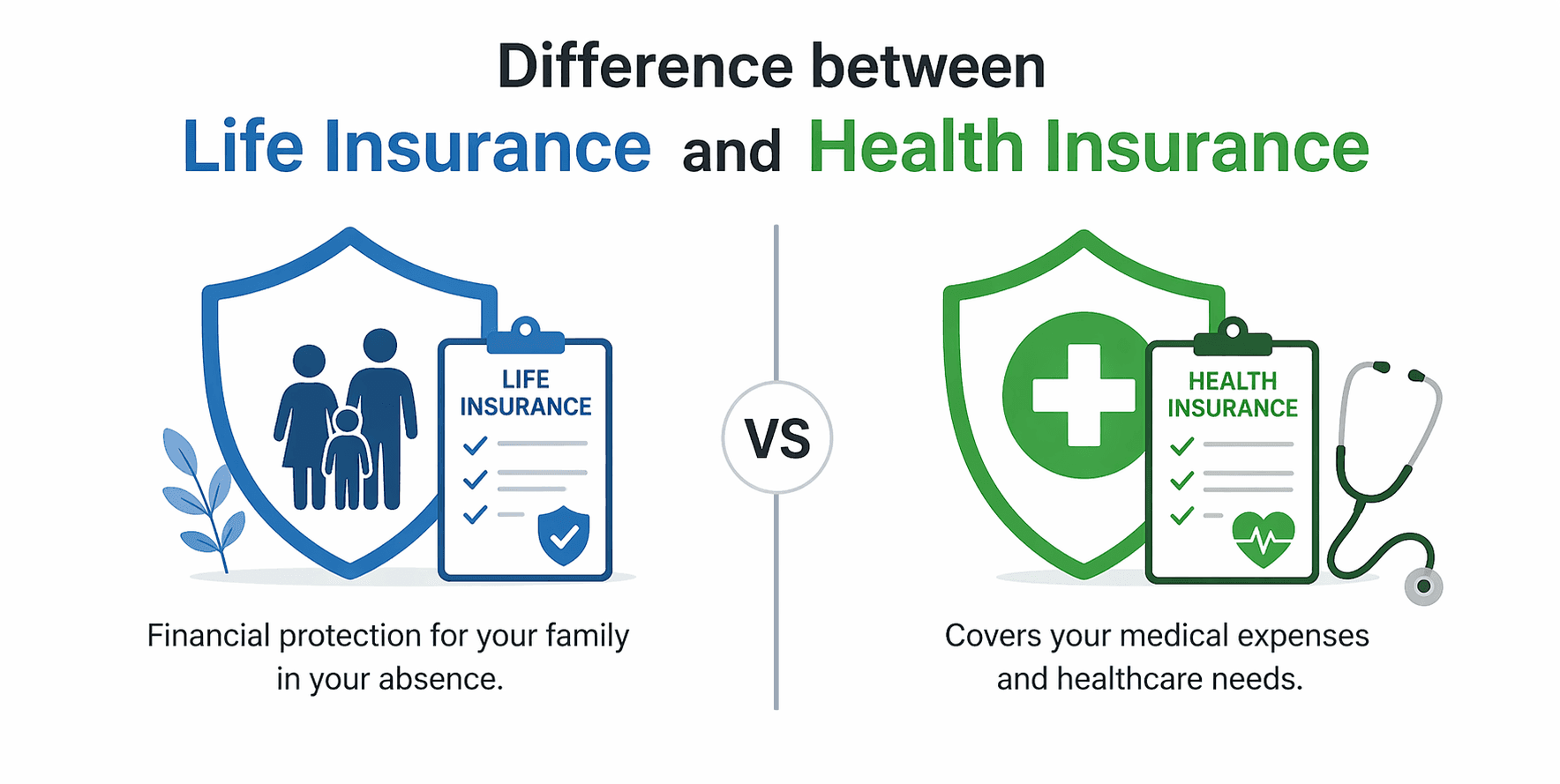
Life insurance and health insurance are two of the most widely purchased types of insurance in India, but they protect against very different risks. Life insurance pays a lump sum to your nominee if you pass away during the policy term. Health insurance pays your hospital bills when you or your family member needs medical treatment.
This guide explains both products in plain language, compares them side by side, lists the actual tax deduction limits under the Income Tax Act, 2025, and helps you decide which one to buy first. A short note on Zurich Kotak's role and the brand boundary with Kotak Mahindra Life Insurance is included below.
Important Note on Brand Boundary
Zurich Kotak General Insurance Company (India) Limited is a general insurance company. It offers Health, Motor, Travel, and other general insurance products. Life Insurance plans are offered by Kotak Mahindra Life Insurance Company Limited, a separate group entity. This article explains both categories for completeness.
What Is Life Insurance?
Life insurance is a contract between you and a life insurance company. In return for a regular premium, the insurer agrees to pay a fixed sum (the Sum Assured) to your nominee if you (the life assured) pass away during the policy term. Some plans also pay a maturity benefit if you survive the term.
The main purpose of life insurance is to replace your income for your family, repay outstanding loans, and help them meet long-term goals such as a child's education or a spouse's retirement.
Types of Life Insurance
Term Insurance: A pure life cover. Pays a lump sum to your nominee if you die during the policy term. No maturity benefit if you survive. Highest cover at the lowest premium.
Whole Life Insurance: Provides life cover up to a very high age, typically 99 or 100 years, depending on the product. Premiums are usually fixed and the policy builds a cash value over time.
Endowment Plans: A life insurance plan that combines life cover with a guaranteed lump-sum benefit if you survive the policy term. Returns are conservative and steady.
Money Back Plans: A type of endowment plan that pays a portion of the Sum Assured at fixed intervals during the policy term and the balance at maturity.
ULIPs (Unit Linked Insurance Plans): A life insurance plan where a part of the premium is invested in market-linked funds you choose, while the balance funds the life cover. The maturity value depends on fund performance.
What Is Health Insurance?
Health insurance is a contract that pays your medical expenses arising from illness, injury, or planned hospitalisation. You pay an annual premium, and the insurer either pays your hospital bill directly (cashless) or reimburses your bill after discharge, up to the Sum Insured chosen by you.
The main purpose of health insurance is to protect your savings from the cost of medical treatment, which has been rising in India at over 10 percent every year.
Types of Health Insurance
Individual Health Insurance: Covers medical expenses for one person. The full Sum Insured is available to that person.
Family Floater Health Insurance : Covers all family members under one policy with a shared Sum Insured.
Senior Citizen Health Insurance: Designed for individuals aged 60 years and above, covering age-related illnesses and hospitalisation.
Critical Illness Insurance : Pays a lump-sum amount on the diagnosis of specified critical illnesses such as cancer, heart attack, stroke, or kidney failure.
Super Top-Up Plans : Provides extra cover that activates after a fixed deductible amount is crossed in a year. Useful for boosting cover at low premium.
Personal Accident Cover : Pays for medical expenses, disability, or death arising from an accident.
Key Differences Between Life Insurance and Health Insurance
The table below compares the two products on the parameters that matter most to a buyer.
Parameter | Life Insurance | Health Insurance |
|---|---|---|
Purpose | Income replacement for the family after the death of the life assured | Reimbursement or cashless payment of medical expenses during the policyholder's lifetime |
Trigger for Claim | Death of the life assured, or policy maturity for endowment / ULIP plans | Hospitalisation, day-care treatment, or specified medical procedure |
Beneficiary | Nominee or legal heir | Policyholder (or hospital directly in cashless claims) |
Tenure | Long-term: 5, 10, 20, 30 years, or whole-of-life | 1 year, 2 years, or 3 years (as permitted by the IRDAI Master Circular dated 29 May 2024) |
Premium | Generally lower for high cover, especially in pure term plans | Varies with age, health status, sum insured, and add-ons chosen |
Savings or Investment Component | Available in Endowment, Money Back, Whole Life, and ULIP plans | Not available; health insurance is a pure protection product |
Tax Benefit (Old Regime) | Up to Rs. 1.5 lakh deduction under Clause 123 of Schedule XV of the Income Tax Act, 2025 (corresponds to Section 80C of the Income Tax Act, 1961) | Up to Rs. 25,000 (Rs. 50,000 for senior citizens), with an additional Rs. 50,000 for premium paid for senior-citizen parents, under Clause 126 of Schedule XV of the Income Tax Act, 2025. Additional Rs. 5,000 allowed for preventive health check-ups within the overall limit. |
Tax Benefit (New Regime) | Most deductions are not available under the new tax regime, which is the default from FY 2023-24 onwards. | Most deductions are not available under the new tax regime. |
Riders or Add-Ons | Accidental Death Benefit, Critical Illness Rider, Waiver of Premium, Term Rider | Zero Co-Pay, Room Rent Waiver, Maternity Cover, OPD Cover, Critical Illness Cover |
Issuing Authority in the Zurich Kotak Group | Kotak Mahindra Life Insurance | Zurich Kotak General Insurance |
Sum Assured vs Sum Insured: Quick Clarification
Even though the two words sound similar, they mean very different things.
Sum Assured (Life Insurance): The guaranteed lump-sum amount the insurer will pay to the nominee on the death of the life assured, or on maturity for endowment plans. It does not change during the policy term unless add-ons are triggered.
Sum Insured (Health Insurance): The maximum amount the insurer will pay in a policy year for medical expenses. It refills at every renewal.
Benefits of Life Insurance
Financial Security for the Family: A lump-sum payout helps the family meet daily expenses and future goals if the life assured passes away during the policy term.
Income Replacement: The Sum Assured replaces lost income, so dependents can maintain their standard of living.
Long-Term Savings and Wealth Building: Endowment, Money Back, and ULIP plans help build a corpus along with life cover.
Loan and Liability Cover: The payout helps the family repay outstanding loans such as a home loan, car loan, or personal loan.
Tax Benefit (Old Regime): Premiums up to Rs. 1.5 lakh are deductible under Clause 123 of Schedule XV of the Income Tax Act, 2025.
Benefits of Health Insurance
Coverage for Medical Expenses: Reimburses or directly pays hospitalisation, surgery, ICU, day-care, and pre- and post-hospitalisation expenses up to the Sum Insured.
Protection from Medical Inflation: Healthcare costs in India have been rising at over 10 percent every year. Health insurance shields your savings from these increases.
Cashless Treatment at Network Hospitals: You can receive treatment at network hospitals without paying upfront. The insurer settles the bill directly.
Critical Illness Cover: Optional add-ons or specific critical illness plans cover serious illnesses such as cancer, heart attack, stroke, and kidney failure.
Preventive Care Benefits: Most policies include free annual health check-ups and wellness rewards that encourage early diagnosis.
Tax Benefit (Old Regime): Premiums up to Rs. 25,000 (Rs. 50,000 for senior citizens) are deductible under Clause 126 of Schedule XV of the Income Tax Act, 2025, with an additional Rs. 50,000 for premium paid for senior-citizen parents.
Which One Should You Buy First?
A practical rule of thumb followed by most financial advisors in India:
Buy Health Insurance First for yourself and your immediate family. Healthcare risks can occur at any age, and a single hospitalisation can wipe out years of savings.
Buy Term Life Insurance Next if you have financial dependents (spouse, children, ageing parents) or outstanding loans. A pure Term Plan offers the highest cover at the lowest premium.
Add Savings or ULIP Plans only after the two protection covers above are in place, and only if the savings goal aligns with your financial plan.
Common Mistakes to Avoid
Buying only one of the two and assuming it covers both risks.
Choosing the cheapest plan without checking room rent caps, co-pay, sub-limits, and the cashless hospital network.
Hiding pre-existing conditions, which can result in claim rejection.
Letting the policy lapse and losing the waiting period credit and No-Claim Bonus.
Buying health insurance only after a health scare. Insurers may decline or load the premium for late buyers.
Confusing endowment plans with mutual funds. Endowment plans are insurance products with conservative returns.
Final Thoughts
Life insurance and health insurance protect against two different but equally important risks. Health insurance protects your savings from the cost of medical treatment during your lifetime. Life insurance protects your family's income if you pass away during the policy term. For most working adults in India with dependents and loans, owning both is the right move. Buy health insurance first, add term life insurance next, and review both covers every year as your life and family change.
Frequently Asked Questions
1. What Is the Key Difference Between Life Insurance and Health Insurance?
Life insurance pays a lump-sum amount to your nominee on the death of the life assured during the policy term. Health insurance pays your medical expenses (hospitalisation, surgery, day-care) up to the Sum Insured while the policy is in force.
2. Do I Need Both Life Insurance and Health Insurance?
Yes, for most adults in India. Health insurance protects your savings from medical expenses. Life insurance protects your family's income if you pass away. The two serve different purposes and do not replace each other.
3. Can I Claim Tax Benefit on Both in the Same Year?
Yes, under the old tax regime. Life insurance premiums qualify under Clause 123 of Schedule XV (up to Rs. 1.5 lakh). Health insurance premiums qualify under Clause 126 of Schedule XV (Rs. 25,000 / Rs. 50,000, plus Rs. 50,000 for senior-citizen parents). Both can be claimed in the same return.
4. Are These Tax Benefits Available Under the New Tax Regime?
No, most Schedule XV deductions are not available under the new tax regime, which is the default from FY 2023-24 onwards. To claim these benefits, you must opt for the old tax regime at the time of filing.
5. Does Health Insurance Cover Pre-Existing Diseases?
Yes, after a waiting period. As per the IRDAI Master Circular on Health Insurance Products dated 29 May 2024, the maximum pre-existing disease waiting period is capped at 36 months. Some plans offer a shorter waiting period of 24 or 12 months.
6. Can I Get Cashless Treatment at Any Hospital?
Cashless treatment is available only at network hospitals empanelled with your insurer. Before admission, check the cashless hospital list on the insurer's website or app, or call the insurer's customer care.
7. Are There Riders Available for Life and Health Insurance?
Yes. Life insurance offers riders such as Accidental Death Benefit, Critical Illness, and Waiver of Premium. Health insurance offers add-ons such as Room Rent Waiver, Maternity Cover, OPD Cover, and Critical Illness Cover.
8. How Often Should I Review My Insurance Policies?
Review your policies at least once a year, or whenever there is a major life change such as marriage, the birth of a child, a job change, a home loan, or a new health condition. Update the Sum Insured, Sum Assured, and nominee details as required.
9. Can I Cancel My Life Insurance Policy Anytime?
You can cancel within the free-look period (typically 15 days, or 30 days for electronic policies) for a full refund minus a small administrative charge. After the free-look period, you can surrender the policy for a surrender value as per the policy terms. Term plans usually have no surrender value.
10. Who Underwrites Life Insurance in the Zurich Kotak Group?
Life Insurance plans are underwritten by Kotak Mahindra Life Insurance Company Limited, a separate group entity. Zurich Kotak General Insurance is a general insurance company that offers Health, Motor, Travel, and other general insurance products.
Explore more on health insurance
Easy access to more, check out these quick links