
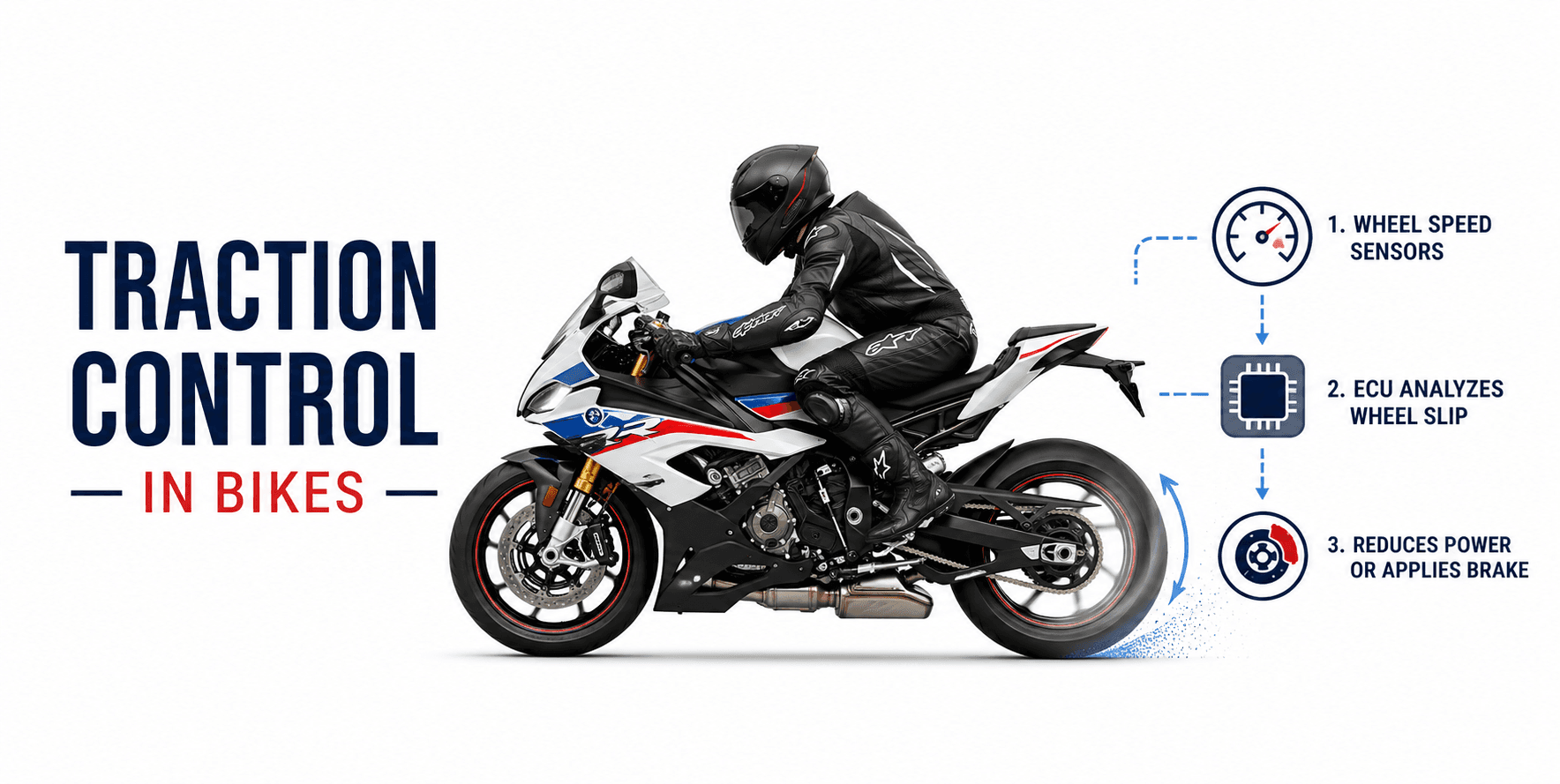
Modern motorcycles are equipped with advanced safety technologies that enhance control and stability in varying road conditions. Among these features, traction management systems play a key role in preventing wheel slip during acceleration. By continuously monitoring wheel speed and adjusting engine output when required, the system helps maintain grip on slippery or uneven surfaces. Once limited to high-performance motorcycles, this technology is now becoming increasingly common across a wide range of two-wheelers in India.
How Traction Control Works in Bikes
Modern motorcycles use traction control as an electronic safety aid to help maintain grip during acceleration. The system relies on sensors fitted to the front and rear wheels that continuously track their rotational speed. Under normal conditions, both wheels move in a coordinated manner, maintaining a consistent speed relationship.
When the system detects that the rear wheel is rotating faster than the front wheel, it identifies this as a potential loss of traction. In such situations, the system intervenes to restore stability and prevent wheel slip.
This intervention typically happens in one or more of the following ways:
Reducing engine power: The Electronic Control Unit (ECU) limits power delivery by adjusting fuel injection or ignition timing to reduce torque to the rear wheel.
Throttle modulation: Electronic throttle systems adjust or soften throttle input to prevent sudden power surges that may cause slippage.
Brake intervention (in advanced systems): In certain setups, brief rear brake application may be used to help regain traction and stabilise the wheel.
These corrections occur almost instantly, often in milliseconds, and are generally imperceptible to the rider. As a result, the motorcycle maintains better stability and grip during acceleration, particularly on low-traction surfaces such as wet roads, gravel, or uneven terrain, as well as during aggressive corner exits.
Why Do You Need a Traction Control System in a Bike?
Traction control is an important rider-assist feature that improves stability and safety by managing wheel grip across different riding conditions. It intervenes when it detects wheel slip, ensuring better control during acceleration and challenging road situations.
Wheel slip: It reduces engine power when the rear wheel spins faster than the front wheel, helping maintain grip on wet, uneven, or loose surfaces and preventing uncontrolled wheel spin during acceleration.
Road stability: On slippery surfaces such as rain-soaked roads, gravel, or sand, the system helps maintain stability by minimising sudden loss of traction and keeping the motorcycle balanced.
Wheelie control: During hard acceleration, especially on powerful bikes, traction control detects excessive front-wheel lift and reduces power delivery to keep both wheels in contact with the road.
Corner safety: While exiting corners, it helps manage abrupt throttle inputs and reduces the risk of rear-wheel slide, supporting smoother and more controlled acceleration.
Rider ease: By automatically adjusting power delivery in low-grip situations, the system reduces the need for constant manual throttle correction, making riding less demanding.
Rider support: It provides an added layer of safety for new or less experienced riders who may not yet have refined throttle control in challenging road conditions.
Overall, traction control enhances riding confidence and safety by offering real-time electronic assistance whenever wheel grip is compromised.
Types of traction control systems in bikes
Traction control systems in bikes vary based on technology and performance level, but all are designed to manage wheel slip and improve stability. The main types are as follows:
1. Reactive traction control
This is the most common type found in mid-range bikes. It reacts after the system detects traction loss. The wheel speed sensors identify that the rear wheel is spinning faster than the front, and the ECU intervenes by cutting power or applying braking. The intervention happens quickly, but there is a brief moment between traction loss and system response.
2. Predictive traction control
Found on premium and high-performance bikes, predictive systems use additional data inputs like lean angle, throttle position, and acceleration rate to anticipate traction loss before it happens. These systems include an Inertial Measurement Unit (IMU) that provides real-time data on the bike’s orientation. Because the system can predict when grip is about to be exceeded, the intervention is smoother and earlier, resulting in minimal disruption to the ride.
3. Multi-level traction control
Many modern bikes offer adjustable traction control with multiple levels. The rider can select the level of intervention based on riding conditions. A higher level provides maximum safety on wet or slippery roads, while a lower level allows more rear wheel slip for sporty riding on dry tarmac. Some systems also allow the rider to turn traction control off entirely, though this is only recommended for experienced riders on controlled surfaces.
Popular bikes in India with traction control
Several motorcycle models in India now come equipped with traction control across segments, ranging from entry-level performance bikes to high-end superbikes. The table below highlights some popular models available in the market.
Bike Model | Engine (CC) | TC Type | Approx. Price (Ex-showroom) |
KTM 390 Duke | 373 | Reactive (switchable) | ₹3.15 lakh |
Royal Enfield Himalayan 450 | 452 | Reactive with ride modes | ₹2.85 lakh |
Kawasaki Ninja 650 | 649 | Reactive (KTRC) | ₹7.20 lakh |
BMW G 310 R | 313 | Reactive (switchable) | ₹2.85 lakh |
Triumph Speed 400 | 398 | Reactive (switchable) | ₹2.35 lakh |
Ducati Panigale V4 | 1103 | Predictive (IMU-based, multi-level) | ₹26.49 lakh |
Prices are approximate and may vary by city and variant. Traction control availability depends on the specific variant.
How to Use Traction Control Effectively
Traction control is most effective when used correctly based on riding conditions and skill level. While it enhances safety by managing wheel slip, it should be used as a support system rather than a replacement for safe riding practices.
Keep Active: Keep traction control switched on during regular riding conditions, such as daily commuting, highway travel, and especially in rain or on unfamiliar roads. Using a higher safety level in these situations helps maintain better grip and overall stability.
Adjust Settings: If your motorcycle offers multiple traction control modes, adjust the level based on road conditions. Higher intervention is suitable for wet, loose, or slippery surfaces, while lower settings can be used on dry, well-maintained roads for more responsive throttle control.
Riding Skills: Traction control should not replace fundamental riding skills. Maintaining proper tyre condition, correct tyre pressure, and smooth throttle control remains essential for safe and consistent riding performance.
Controlled Use: Disabling traction control should only be done in controlled environments, such as a race track, and by experienced riders. Turning it off on public roads, especially without sufficient skill, can increase the risk of losing control and having accidents.
Even with traction control, unexpected situations can still occur on the road. That is why having the right bike insurance matters just as much as riding safety features. A comprehensive plan from Zurich Kotak General Insurance helps protect you from financial stress in the event of an accident or damage, so every ride feels more secure and confident.
Conclusion
Traction control is a key motorcycle safety feature that helps maintain grip by detecting wheel slip and adjusting engine power or braking when needed. Whether reactive, predictive, or multi-level, these systems are designed to improve stability in real-world conditions such as wet roads, loose surfaces, and sudden acceleration. As this technology becomes more common across a wide range of bikes in India, it supports safer and more confident riding in everyday situations. For the best results, riders should keep the system active, understand its settings, and combine it with responsible riding habits and proper bike maintenance to ensure consistent safety on the road.
FAQs
Q1: What is traction control in a bike?
It is an electronic system that prevents the rear wheel from spinning excessively by adjusting engine power or braking to maintain grip.
Q2: Can I turn off traction control on my bike?
Most bikes with traction control allow it to be switched off, but this is recommended only for experienced riders and in controlled environments such as race tracks.
Q3: Does traction control work in the rain?
Yes, wet roads are one of the most effective conditions for traction control, as the system helps prevent rear wheel spin on slippery surfaces.
Q4: Is traction control the same as ABS?
No. ABS prevents wheel lock during braking, while traction control prevents wheel spin during acceleration. Both systems work together to improve overall riding safety.
Q5: Does traction control affect motorcycle performance?
Traction control does not reduce overall motorcycle performance. It may temporarily reduce engine power when wheel slip is detected to help maintain grip and stability during acceleration.
Q6: Is traction control useful for beginner riders?
Yes, traction control is especially useful for beginner riders as it helps manage wheel slip during acceleration and provides additional safety support in varying road conditions.