
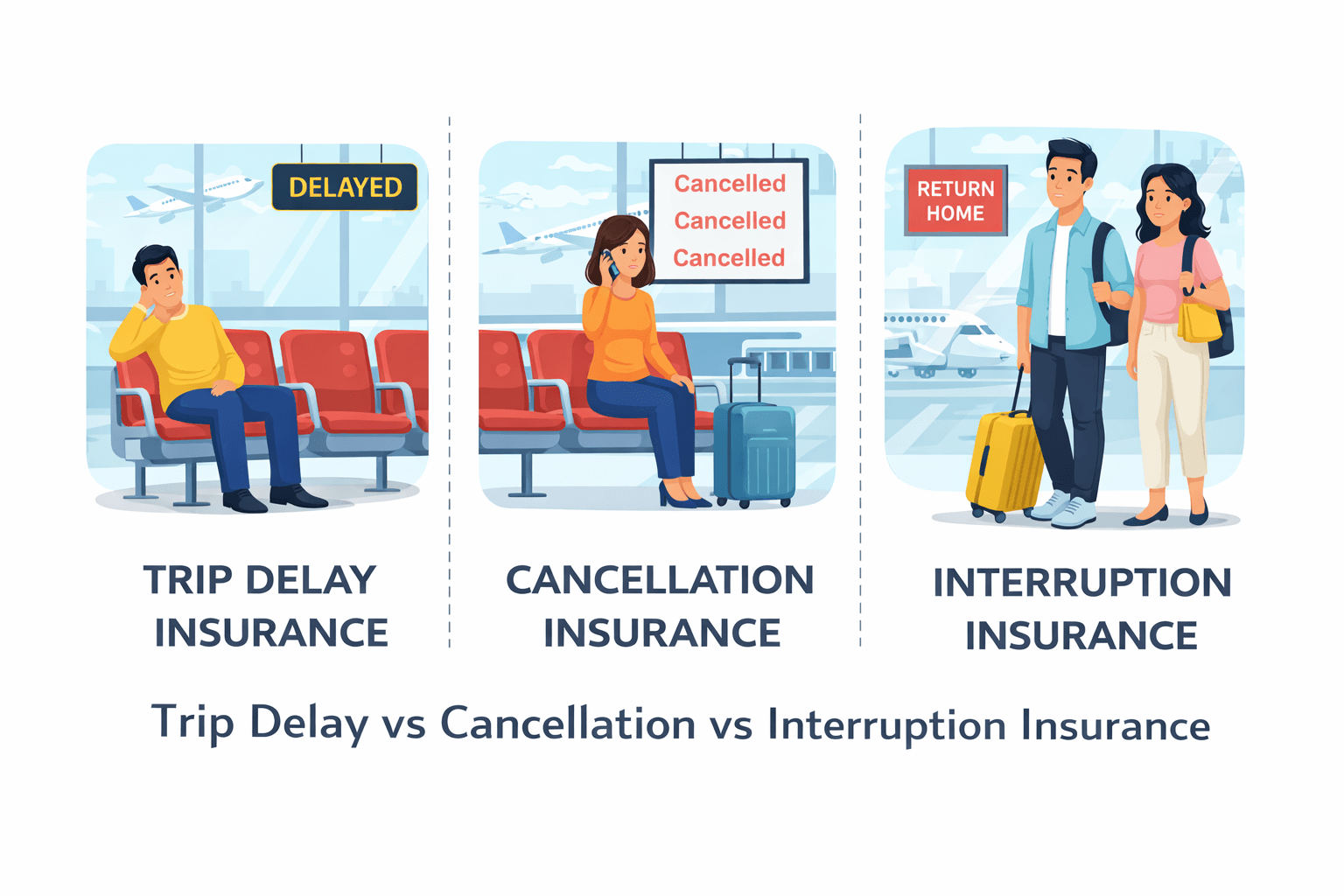
Travel is one of life's greatest joys, offering new experiences, memories, and adventures. However, unexpected events can disrupt even the best-planned trips, leading to financial losses and stress. From flight delays and trip cancellations due to medical emergencies to interruptions caused by family crises or natural disasters, travel disruptions can happen to anyone.
This comprehensive guide explains three essential types of travel insurance protection: trip cancellation insurance, trip delay insurance, and trip interruption insurance. Understanding the differences between these covers and what each protects you against will help you choose the right coverage for your travel needs. With proper travel insurance from Zurich Kotak General Insurance, you can travel with confidence, knowing your financial investment is protected.
Understanding the Three Types of Travel Insurance Coverage
Travel insurance offers three distinct protections for different scenarios:
Trip Cancellation Insurance
Protects your financial investment if you need to cancel your trip before departure.
Coverage Details: Reimburses non-refundable expenses like flights, hotels, tours, and activity bookings if you cancel for a covered reason.
When It Applies: Applies to cancellations that occur BEFORE your journey starts.
Claim Process & Amounts: You must claim within 30-90 days of cancellation.
Trip Delay Insurance
Compensates you for additional expenses incurred when your travel is significantly delayed.
Coverage Details: Covers accommodation, meals, transport, and essentials when delays exceed the policy threshold.
When It Applies: Applies to delays that occur DURING your journey (typically 6-12 hour threshold, though some premium plans start at 3-4 hours).
Claim Process & Amounts: Payout models vary: per-hour compensation (₹500-₹1,000 per hour after threshold) or lump-sum compensation (₹2,000-₹5,000 once threshold is reached).
Trip Interruption Insurance
Reimburses you for unused trip expenses if your journey is cut short and you must return home.
Coverage Details: Covers unused prepaid expenses like hotels, tours, and one-way emergency return transportation.
When It Applies: Applies to interruptions that occur AFTER your journey has already started.
Claim Process & Amounts: Typical coverage limits range from ₹2 lakh to ₹50 lakh depending on your plan selection.
Quick Comparison: Trip Cancellation vs Delay vs Interruption
Feature | Trip Cancellation | Trip Delay | Trip Interruption |
Coverage Timing | Before departure | During travel (delay period) | After trip starts (mid-journey) |
Payout Type | Reimbursement of cancelled bookings | Per-hour or lump-sum compensation | Reimbursement of unused expenses + return fare |
Typical Trigger | Medical emergency, visa denial, family death | 6-12 hour flight/transport delay | Mid-trip illness, family emergency, home damage |
Coverage Limit Range | ₹2 lakh - ₹50 lakh | ₹500-₹1,000/hour or ₹2,000-₹5,000 lump-sum | ₹2 lakh - ₹50 lakh |
Claim Deadline | 30-90 days after cancellation | 7-30 days after delay ends | 30-90 days after interruption |
Important Coverage Limitations and Exclusions
Before purchasing travel insurance, be aware of these common limitations:
Waiting Period: Most travel insurance policies have a waiting period of 7-14 days after purchase. Reasons claimed within this period may not be covered.
Age Restrictions: Typically, travel insurance covers travellers up to age 75-80 years. Seniors may need special senior travel insurance or age-waiver plans.
Pre-existing Medical Conditions: Medical conditions that existed before policy purchase are generally excluded unless you opt for pre-existing condition coverage (available at higher premiums).
High-Risk Destinations: Travel to countries with travel advisories, ongoing conflicts, or civil unrest may not be covered or may require additional premium.
Alcohol and Drug-Related Incidents: Claims arising from cancellations or incidents caused by alcohol or drug influence are typically excluded.
Travel During Pandemic: Check your policy carefully—some insurers exclude or limit coverage for travel during disease outbreaks or pandemic-related cancellations.
Step-by-Step Claim Filing Guide
Claiming travel insurance involves several important steps:
Document the Reason: Obtain proof of the cause immediately. For medical emergencies, get a doctor's certificate. For visa rejections, obtain official rejection letters. For airline delays, collect boarding passes and airline confirmation. For natural disasters, obtain news reports or official confirmation from authorities.
Notify Your Insurer Promptly: Inform your insurance provider within 24-48 hours of the incident. Most insurers have 24/7 helplines and online claim intimation portals for convenience.
Gather Original Documents: Collect all original receipts and invoices for affected expenses (hotels, flights, tours, meals). Digital receipts from airlines or hotels are typically accepted if they include transaction details, date, amount, and vendor name.
Submit Claim Documentation: Prepare a complete claim file including: Completed claim form, Proof of payment (booking confirmations, invoices, credit card statements), Supporting documents (medical certificates, airline reports, rejection letters), Policy document, Proof of identity and travel dates.
Track Claim Status: Monitor your claim status regularly through your insurer's portal or customer service. Most insurers settle travel insurance claims within 7-30 days if all documents are complete. If requested for additional information, respond within 10-14 days to avoid delays. Claims not actioned for 90+ days may be considered abandoned.
Protect Your Travel Investment Today
Unforeseen circumstances can turn a dream holiday into a financial nightmare. Whether it's a sudden illness forcing you to cancel, a flight delay causing extra expenses, or a family emergency interrupting your journey, travel insurance provides peace of mind and financial protection.
Zurich Kotak General Insurance offers flexible travel insurance plans tailored to your needs. Choose between annual multi-trip coverage for frequent travellers or single-trip insurance for occasional trips. Get instant quotes, compare plans, and purchase your policy online in minutes.
Get Your Travel Insurance Quote Now
Frequently Asked Questions
Q1: What is considered "immediate family" for interruption claims?
Immediate family typically includes your spouse, children, and parents. However, definitions vary by insurer and policy. Check your policy wording to confirm which family members are covered.
Q2: Can I claim for a trip cancelled due to work reasons?
Work-related cancellations are generally not covered. However, some premium plans offer "job loss" coverage if you lose employment involuntarily. A change in work schedule or voluntary resignation typically does not qualify.
Q3: What's the difference between per-hour and lump-sum trip delay compensation?
Per-hour compensation: You receive ₹500-₹1,000 for each hour of delay beyond the threshold (e.g., after 6-12 hours). Lump-sum compensation: You receive a one-time payment of ₹2,000-₹5,000 once the threshold delay is reached, regardless of how much longer you're delayed.
Q4: Do I need to purchase insurance immediately after booking my trip?
While you can purchase insurance at any time before your trip, buying within 7-14 days of your initial trip booking activates better coverage and avoids waiting period complications. Later purchases may have shorter coverage windows.
Q5: Are pre-existing medical conditions covered?
Standard policies exclude pre-existing conditions. However, if you purchase insurance within 7-14 days of your initial trip booking, some insurers waive this exclusion automatically. Alternatively, opt-in for pre-existing condition coverage (at higher premium) for explicit coverage.
Q6: What happens if I forget to claim within the deadline?
Most insurers allow claims within 30-90 days of the incident. Claims filed after this window are typically rejected. Mark your calendar and file promptly—delays are not usually entertained.
Q7: Why choose Zurich Kotak General Insurance for travel coverage?
Zurich Kotak offers comprehensive travel insurance with industry-leading 96.4% health insurance claim settlement ratio, 24/7 multilingual assistance, quick claim processing (typically within 7 days for complete documentation), and coverage for both domestic and international travel. Our experienced team ensures transparent, hassle-free claim settlement.
Q8: What is trip interruption insurance?
Trip interruption insurance reimburses the unused, non-refundable portion of your trip and the additional one-way cost of returning home early when a covered event, such as a medical emergency or unrest at your destination, forces you to cut a journey short after it has started. Unlike trip cancellation, which applies before you leave, it activates once travel is under way.
Q9: When does trip interruption cover pay out?
Trip interruption cover pays out when a covered event forces you to end a trip early and return home after it has begun, for example a medical emergency involving you or a family member, a natural disaster or political unrest at your destination, or serious damage to your home. It reimburses unused prepaid bookings and the extra return travel cost, subject to your plan's limits and terms.