
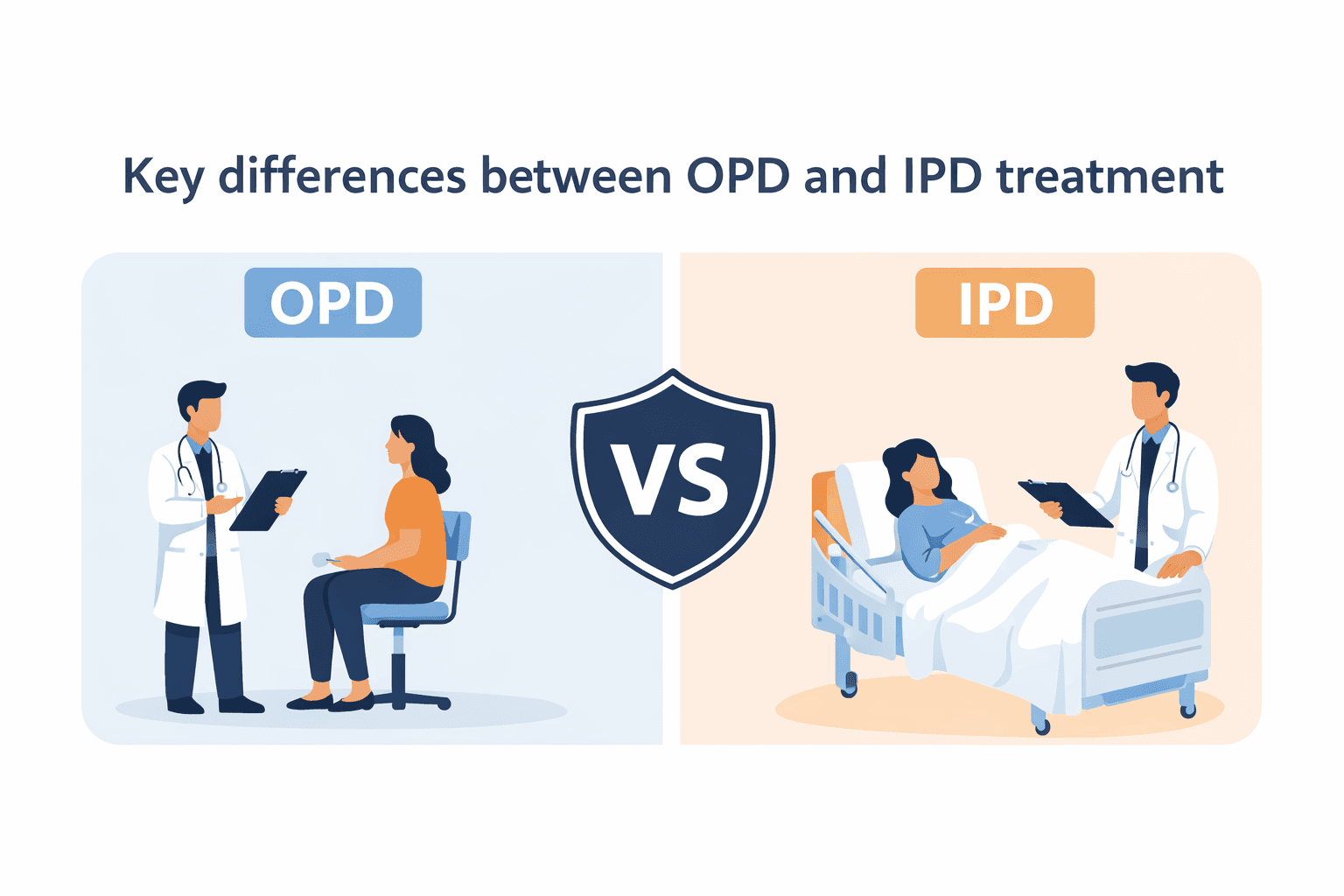
When it comes to health insurance, understanding the difference between OPD and IPD is essential for choosing the right plan. OPD (Out-Patient Department) and IPD (In-Patient Department) are two categories of medical treatment used by hospitals to classify patient care. The way your insurer handles these two types of treatment directly impacts your coverage and claim eligibility. Many policyholders are unaware that standard health insurance plans primarily cover IPD expenses, whereas OPD coverage is often available only as an add-on.
What is OPD (Out-Patient Department)?
OPD refers to the hospital department where patients receive diagnosis, consultation, and treatment without being admitted. You visit the hospital, consult a doctor, get prescribed medicines or tests, and return home the same day. No overnight stay is required. Common examples of OPD treatments include:
Doctor consultations and follow-up visits.
Diagnostic tests such as blood work, X-rays, and scans.
Minor wound dressing and vaccinations.
Pharmacy purchases for prescribed medicines.
Routine dental check-ups and minor dental procedures.
What is IPD (In-Patient Department)?
IPD refers to the department where patients are formally admitted to the hospital and require a stay of at least 24 hours. This includes surgeries, intensive care, and treatments that need continuous medical supervision. IPD treatment typically involves:
Hospitalisation for surgeries and major medical procedures.
ICU and critical care treatment.
Room rent, nursing charges, and hospital meals.
Post-operative monitoring and recovery.
Daycare procedures (treatments that require less than 24 hours but are classified as IPD by insurers).
Difference between OPD and IPD in health insurance
The following table highlights the key difference between OPD and IPD in health insurance to help you understand how each is treated under health insurance:
Parameter | OPD (Out-Patient) | IPD (In-Patient) |
Hospital admission | Not required | Required (minimum 24 hours) |
Treatment type | Consultations, tests, and minor procedures | Surgeries, intensive care, major treatments |
Duration | Same-day visit; patient goes home | Overnight or multi-day hospital stay |
Cost | Generally lower per visit | Significantly higher due to room rent, surgery, and ICU |
Health insurance coverage | Usually not covered in standard plans; available as an add-on | Covered under most standard health insurance plans |
Claim process | Reimbursement-based or through OPD add-on | Cashless or reimbursement at network hospitals |
Examples | Doctor visit, blood test, dental cleaning | Appendectomy, knee replacement, cardiac surgery |
What is OPD cover in health insurance?
Most standard health insurance plans in India cover only IPD expenses. OPD cover in health insurance is typically offered as an optional add-on or as part of specific plans. When you have OPD coverage, your policy reimburses expenses for doctor consultations, diagnostic tests, pharmacy bills, and minor treatments that do not require hospitalisation. Here is what OPD cover generally includes:
Consultation fees for specialists and general physicians.
Prescribed diagnostic tests and lab work.
Pharmacy expenses for prescribed medicines.
Dental consultations and basic dental treatments.
Vision-related expenses, such as eye check-ups.
OPD add-ons are particularly useful for families with regular doctor visits, ongoing medication needs, or chronic conditions requiring frequent consultations. While the add-on comes at an additional premium, it can help offset recurring out-of-pocket medical expenses.
Is dental treatment OPD or IPD?
Dental treatment is generally classified as OPD since most dental procedures, such as cleaning, fillings, extractions, and routine check-ups, do not require hospital admission. However, complex dental surgeries that need general anaesthesia and an overnight hospital stay may fall under IPD. In terms of health insurance, routine dental treatments are usually not covered under standard plans. Some policies include dental coverage as an OPD add-on, while dental procedures arising from an accident are typically covered under the base policy. Always check your policy terms to understand whether your dental expenses qualify for OPD or IPD coverage.
Why does understanding OPD and IPD matter for your health insurance?
Understanding OPD and IPD is crucial for choosing the right health insurance, as it determines which medical expenses are covered and how health insurance claims are processed.
Better plan selection: Knowing the difference between IPD and OPD helps you choose a plan that matches your actual healthcare needs. If you visit doctors frequently, an OPD add-on can save you money.
Avoid claim rejections: Many claim rejections happen because policyholders assume OPD expenses are covered under standard plans. Understanding your coverage prevents surprises.
Optimise expenses: For families with senior members or those managing chronic conditions, OPD expenses can add up. Having the right coverage reduces your overall healthcare spending.
Plan for the future: As you age, OPD visits tend to increase. Adding OPD cover early on ensures you are prepared for changing healthcare needs.
How to choose the right OPD and IPD coverage?
Choosing the right OPD and IPD coverage requires evaluating your medical needs, treatment frequency, and budget to ensure comprehensive protection without unnecessary costs.
Review Your Medical History: If you or your family members visit doctors regularly for consultations or tests, consider a plan with OPD cover.
Check Add-On Options: Many insurers offer OPD benefits as an add-on. Compare the additional premium against your expected annual OPD spending.
Prioritise IPD Coverage: Hospitalisation costs are significantly higher than OPD expenses. Ensure your base policy provides strong IPD coverage before adding OPD benefits.
Look at Network Hospitals: Choose an insurer with a wide cashless hospital network for IPD claims and check if OPD benefits are available at the same facilities.
Conclusion
Understanding the distinction between OPD and IPD is essential for making informed health insurance decisions. While IPD coverage forms the core of most standard plans, OPD benefits are often optional but valuable for regular consultations, tests, and minor treatments. Evaluating your healthcare needs, considering add-on options, and prioritising strong IPD coverage ensures comprehensive protection and cost efficiency. By choosing the right balance of OPD and IPD coverage, you can safeguard your health while minimising out-of-pocket expenses and avoiding unexpected claim denials.
Read more - Health Insurance: Complete Overview of What, Why, How & Coverage
FAQs
What is the main difference between OPD and IPD?
OPD treatments do not require hospital admission, while IPD treatments involve a hospital stay of at least 24 hours. Standard health insurance plans cover IPD expenses, while OPD expenses are usually covered only through add-ons.
Does health insurance cover OPD expenses?
Most standard plans do not cover OPD expenses. However, many insurers offer OPD cover as an optional add-on to health insurance that reimburses consultation fees, diagnostic tests, and pharmacy bills.
Is dental treatment OPD or IPD?
Routine dental treatments such as cleanings, fillings, and extractions are classified as OPD. Complex dental surgeries requiring hospital admission may fall under IPD. Check your policy for specific dental coverage terms.
Are daycare procedures covered under OPD or IPD?
Daycare procedures such as dialysis, chemotherapy, and cataract surgery are classified as IPD by most insurers, even though they do not require a 24-hour stay. They are covered under standard health insurance plans.
Can I add OPD cover to my existing health insurance?
Many insurers allow you to add OPD coverage at the time of renewal. The additional premium depends on the coverage limit and the insurer's terms.
What expenses are covered under the OPD add-on?
OPD add-ons typically cover doctor consultations, diagnostic tests, prescribed medicines, dental check-ups, and vision care. The coverage limit and eligible expenses vary by insurer and plan.
Explore more on health insurance
Easy access to more, check out these quick links