
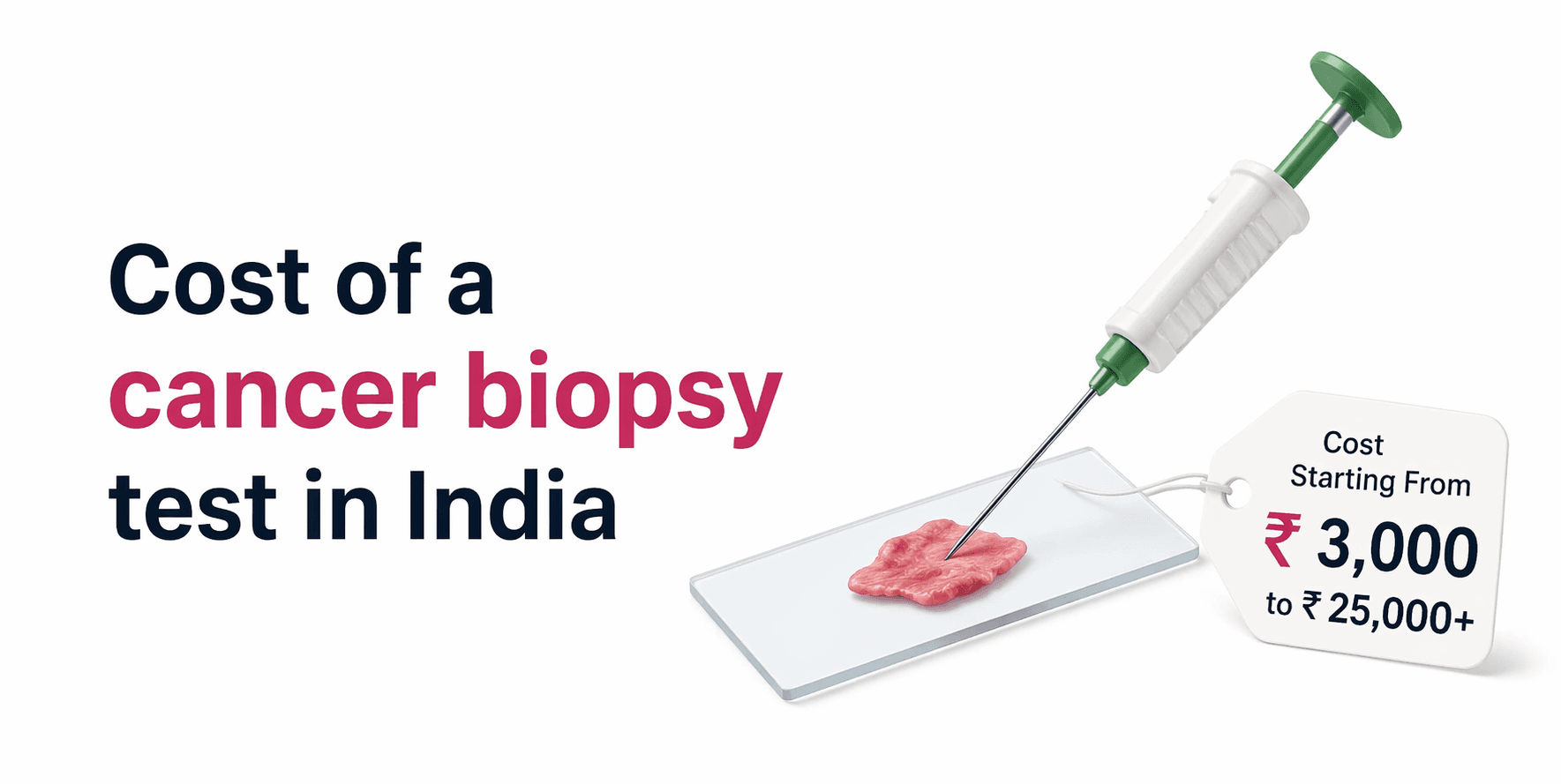
When a scan shows an abnormality, the next step is to understand its exact nature. A biopsy is a diagnostic procedure that helps provide this clarity. It involves removing a small sample of tissue or cells and examining it under a microscope. While imaging tests like CT, MRI, and ultrasound can detect unusual growths, only a biopsy can confirm whether the condition is cancerous, pre-cancerous, or non-cancerous.
The cost of a biopsy in India can vary depending on the type of procedure, the body part involved, the hospital, and whether imaging guidance is required. Having a clear understanding of these factors can help you plan this important diagnostic step with greater confidence and clarity.
What is a biopsy?
A biopsy involves extracting a small sample of tissue or cells from an abnormal area in the body and sending it to a pathology laboratory for examination. A pathologist analyses the sample under a microscope to determine whether abnormal or cancerous cells are present, what type of cancer it is, how severe it may be, and whether it has specific markers that influence treatment decisions. Biopsies are performed on almost any part of the body, including the skin, breast, liver, lung, kidney, bone marrow, lymph nodes, and digestive tract.
A biopsy is typically recommended when imaging tests reveal an abnormal growth, lump, or mass that needs further investigation. It is the definitive test for cancer diagnosis and is essential before any cancer treatment plan can be started.
Types of biopsies and their costs in India
The biopsy test price varies significantly based on the type of procedure performed. Each type is suited to a specific clinical scenario based on the location of the abnormal tissue and the level of detail required.
Fine Needle Aspiration Cytology (FNAC): A thin needle is inserted into the abnormal lump or mass to aspirate (draw out) a small sample of cells. FNAC is commonly used for superficial lumps in the breast, thyroid, and lymph nodes. The procedure is quick, minimally invasive, and usually performed in an outpatient setting without anaesthesia. The price of an FNAC biopsy ranges from approximately ₹800 to ₹2,500.
Core needle biopsy: A slightly larger needle with a cutting edge is used to extract a small cylinder of tissue from the suspicious area. Core needle biopsy provides more tissue than FNAC, allowing for a more detailed histopathological analysis. It is commonly used for breast, liver, kidney, and prostate biopsies. The cost ranges from approximately ₹2,000 to ₹6,000.
Skin biopsy: A small section of skin is removed for examination. Skin biopsies are performed to diagnose conditions like melanoma, basal cell carcinoma, squamous cell carcinoma, and other skin disorders. Techniques include punch biopsy (a circular blade removes a small core of skin), shave biopsy (a thin layer is shaved off), and excisional biopsy (the entire lesion is removed). The cost ranges from approximately ₹1,000 to ₹3,000.
Bone marrow biopsy: A needle is inserted into a large bone, usually the hip bone (iliac crest), to extract a sample of bone marrow. This procedure is used to diagnose blood cancers such as leukaemia, lymphoma, and multiple myeloma, as well as other bone marrow disorders, including anaemia and infections. The cost ranges from approximately ₹3,000 to ₹10,000.
Image-guided biopsy (CT-guided or ultrasound-guided): When the suspicious area is deep inside the body and cannot be felt from the surface, imaging technology, such as a CT scan or an ultrasound, is used to guide the needle precisely to the target tissue. This is common for lung, liver, abdominal, and pelvic biopsies. The use of imaging guidance adds to the procedure cost due to the equipment and the involvement of a specialist radiologist. The cost ranges from approximately ₹5,000 to ₹15,000.
Endoscopic biopsy: A thin, flexible tube with a camera (endoscope) is inserted through the mouth, rectum, or other natural openings to reach internal organs like the stomach, colon, oesophagus, or lungs. A small tool passed through the endoscope collects the tissue sample. This procedure is used to diagnose gastrointestinal, lung, and bladder cancers. The cost ranges from approximately ₹4,000 to ₹12,000.
Surgical biopsy (incisional or excisional): A surgeon makes an incision to access and remove part of the abnormal tissue (incisional biopsy) or the entire mass (excisional biopsy). Surgical biopsies are performed when other methods cannot provide a sufficient sample or when the mass needs to be removed entirely for both diagnosis and treatment. These are the most complex and expensive biopsy types, requiring operating room facilities, anaesthesia, and post-operative care. The cost ranges from approximately ₹8,000 to ₹50,000 or more.
Note: Costs are indicative and may vary by hospital, city, and individual medical needs.
Summary of biopsy test prices in India
Biopsy costs in India vary depending on the type of procedure, the organ involved, and the level of medical equipment required.
Type of Biopsy | Approx. Cost Range (₹) | Commonly Used For |
FNAC (Fine Needle Aspiration) | 800 to 2,500 | Breast, thyroid, and lymph node lumps. |
Core needle biopsy | 2,000 to 6,000 | Breast, liver, kidney, prostate. |
Skin biopsy | 1,000 to 3,000 | Melanoma, skin cancers, skin conditions. |
Bone marrow biopsy | 3,000 to 10,000 | Blood cancers, bone marrow disorders. |
Image-guided biopsy (CT/USG) | 5,000 to 15,000 | Lung, liver, abdominal, pelvic masses. |
Endoscopic biopsy | 4,000 to 12,000 | GI cancers, lung, and bladder cancers. |
Surgical biopsy (incisional/excisional) | 8,000 to 50,000+ | Complex or deep-seated tumours. |
Factors affecting biopsy test price in India
The cost of a biopsy test in India is not fixed. It changes based on several medical and hospital-related factors.
Type of biopsy: Simple needle-based procedures like FNAC cost a fraction of surgical biopsies that require anaesthesia and operating room facilities.
Body part involved: Biopsies of easily accessible areas (skin, breast, thyroid) are cheaper than those requiring imaging guidance or endoscopic access to internal organs.
Use of imaging guidance: CT-guided or ultrasound-guided biopsies cost more due to the equipment, radiology charges, and specialist fees involved.
Hospital type and city. Private multi-speciality hospitals in metro cities charge more than government hospitals or smaller diagnostic centers. Government hospitals may offer biopsies at significantly lower rates or at no cost under public health schemes.
Pathology analysis. The basic histopathology report may be included in the biopsy cost, but advanced testing like immunohistochemistry (IHC), molecular testing, or genetic marker analysis is charged separately and can add ₹5,000 to ₹20,000 or more.
Anaesthesia. Procedures that require local anaesthesia are cheaper than those needing sedation or general anaesthesia.
Post-biopsy care. If the procedure requires overnight observation or post-operative monitoring, hospital stay charges are added to the total cost.
City-wise comparison of biopsy costs in India
The cost of diagnostic procedures can vary significantly across metropolitan hubs due to differences in hospital infrastructure, laboratory overheads, and the availability of specialised radiologists. Below is a comparative breakdown of estimated biopsy costs across major Indian cities:
City | FNAC (Approx.) | Core Needle (Approx.) | Image-Guided (Approx.) |
Delhi NCR | ₹800 to ₹2,500 | ₹2,500 to ₹6,000 | ₹6,000 to ₹15,000 |
Mumbai | ₹1,000 to ₹3,000 | ₹3,000 to ₹7,000 | ₹7,000 to ₹16,000 |
Bangalore | ₹900 to ₹2,500 | ₹2,500 to ₹6,000 | ₹6,000 to ₹14,000 |
Chennai | ₹800 to ₹2,000 | ₹2,000 to ₹5,500 | ₹5,000 to ₹13,000 |
Hyderabad | ₹800 to ₹2,000 | ₹2,000 to ₹5,000 | ₹5,000 to ₹12,000 |
Kolkata | ₹700 to ₹1,800 | ₹1,500 to ₹4,500 | ₹4,000 to ₹10,000 |
In high-cost cities like Mumbai and Delhi, costs can escalate quickly. Zurich Kotak General Insurance provides access to network hospitals, allowing you to avail of cashless biopsy procedures at top-tier facilities, saving you from significant upfront out-of-pocket expenses.
Disclaimer: Costs can vary based on the hospital, city, and individual medical needs.
What to expect during a biopsy procedure
A biopsy is a simple medical procedure, but knowing what happens before, during, and after it can help you feel more prepared.
Before the procedure
The doctor reviews your medical history, current medications, and any allergies. You may be asked to stop blood thinners a few days before the biopsy. For procedures requiring sedation or general anaesthesia, fasting for 6 to 8 hours is required. The doctor explains the procedure, risks, and what the results will indicate, and you sign a consent form.
During the procedure
For needle-based biopsies (FNAC, core needle), the area is cleaned and numbed with local anaesthesia. The needle is inserted, the sample is collected, and the needle is withdrawn. The entire process takes 10 to 30 minutes. For image-guided biopsies, the same process occurs under CT or ultrasound guidance to ensure precision. For endoscopic biopsies, the endoscope is inserted, the target area is visualised on a screen, and the sample is collected through the scope. Surgical biopsies involve an incision under local or general anaesthesia, sample collection, and wound closure with stitches.
After the procedure
Minor discomfort, soreness, or bruising at the biopsy site is common and resolves within a few days. For needle biopsies, you can typically leave the clinic within an hour. For surgical biopsies, a few hours of observation or an overnight stay may be needed. The tissue sample is sent to the pathology lab, and results are usually available within 3 to 7 working days. Advanced molecular or genetic testing may take longer.
Understanding biopsy results
Biopsy results help doctors understand the nature of the tissue and guide the next steps in diagnosis or treatment. Biopsy results typically indicate one of the following:
Benign: No cancer cells detected. The tissue is normal or shows a non-cancerous condition.
Pre-cancerous (dysplasia): Abnormal cells are present that have the potential to become cancerous if left untreated. Monitoring or preventive treatment may be recommended.
Malignant (cancerous): Cancer cells are confirmed. The pathology report provides details on the cancer type, grade (how aggressive it is), and specific markers that guide treatment decisions.
Inconclusive: The sample may be insufficient or unclear. A repeat biopsy or alternative procedure may be recommended.
Does health insurance cover biopsy tests in India?
Biopsy tests are generally covered by most health insurance plans. However, for outpatient procedures like FNAC or Core Biopsy, you need a policy that explicitly covers Daycare treatments. Zurich Kotak General Insurance offers comprehensive plans that bridge this gap, covering everything from the surgeon's fee to the final pathology report, even if hospitalisation is less than 24 hours.
Key points to check with your insurer include whether the biopsy is covered under daycare or requires a minimum hospitalisation period, whether advanced pathology tests like IHC and molecular testing are included in the coverage, and whether the hospital or diagnostic centre is in the insurer’s network for cashless claims.
How to reduce biopsy test costs
Biopsy tests can be expensive in some cases, but a few smart choices can help you manage and reduce the overall cost without compromising on quality.
Use health insurance: If your policy covers diagnostics, the biopsy cost can be partially or fully covered, reducing out-of-pocket expenses.
Compare prices across hospitals and labs: Pathology labs and diagnostic centres often charge less than hospital-based biopsies for the same procedure.
Ask about package pricing: Some hospitals offer bundled biopsy packages that include the procedure, pathology, and follow-up consultation at a fixed price.
Consider government hospitals: Government and trust-run hospitals offer biopsies at significantly lower costs. Under schemes like Ayushman Bharat, eligible patients can access these services free of charge.
Conclusion
The biopsy test price in India ranges from ₹800 for a simple FNAC to ₹50,000 or more for a complex surgical biopsy, depending on the type of procedure, the body part, the hospital, and whether imaging guidance or advanced pathology testing is involved. A biopsy is the definitive test for confirming or ruling out cancer and is essential before any treatment plan can begin. Health insurance covers biopsy procedures in most cases, and comparing prices across hospitals, using insurance, and considering government hospital options are effective ways to manage the cost. Zurich Kotak General Insurance offers health insurance plans that cover diagnostic procedures, including biopsies, helping you access timely diagnosis without financial worry.
FAQs
Q1: How much does a biopsy test cost in India?
The price of biopsy tests ranges from ₹800 for FNAC to ₹50,000+ for surgical biopsies, depending on the type, hospital, and city.
Q2: Is a biopsy painful?
Most biopsies use local anesthesia and involve minimal discomfort. Surgical biopsies may cause soreness that resolves within a few days.
Q3: How long do biopsy results take?
Standard histopathology results take 3 to 7 working days. Advanced molecular or genetic testing may take 2 to 3 weeks.
Q4: Does health insurance cover biopsy tests?
Yes, most health insurance plans cover medically prescribed biopsies. Check whether your policy covers outpatient or daycare procedures.
Q5: What is the difference between FNAC and core needle biopsy?
FNAC aspirates cells with a thin needle. Core needle biopsy extracts a small tissue cylinder, providing more material for detailed analysis.
Q6: Can a biopsy confirm whether a tumour is cancerous?
Yes, a biopsy is the only definitive test that can confirm cancer. Imaging tests can detect masses, but cannot determine if they are malignant.
Q7: Is a biopsy covered under Ayushman Bharat?
Yes, eligible beneficiaries can access biopsy and other diagnostic procedures free of charge at impanelled hospitals under the scheme.
Q8: What happens if biopsy results are inconclusive?
The doctor may recommend a repeat biopsy, a different biopsy technique, or additional imaging to obtain a clearer diagnosis.
Explore more on health insurance
Easy access to more, check out these quick links