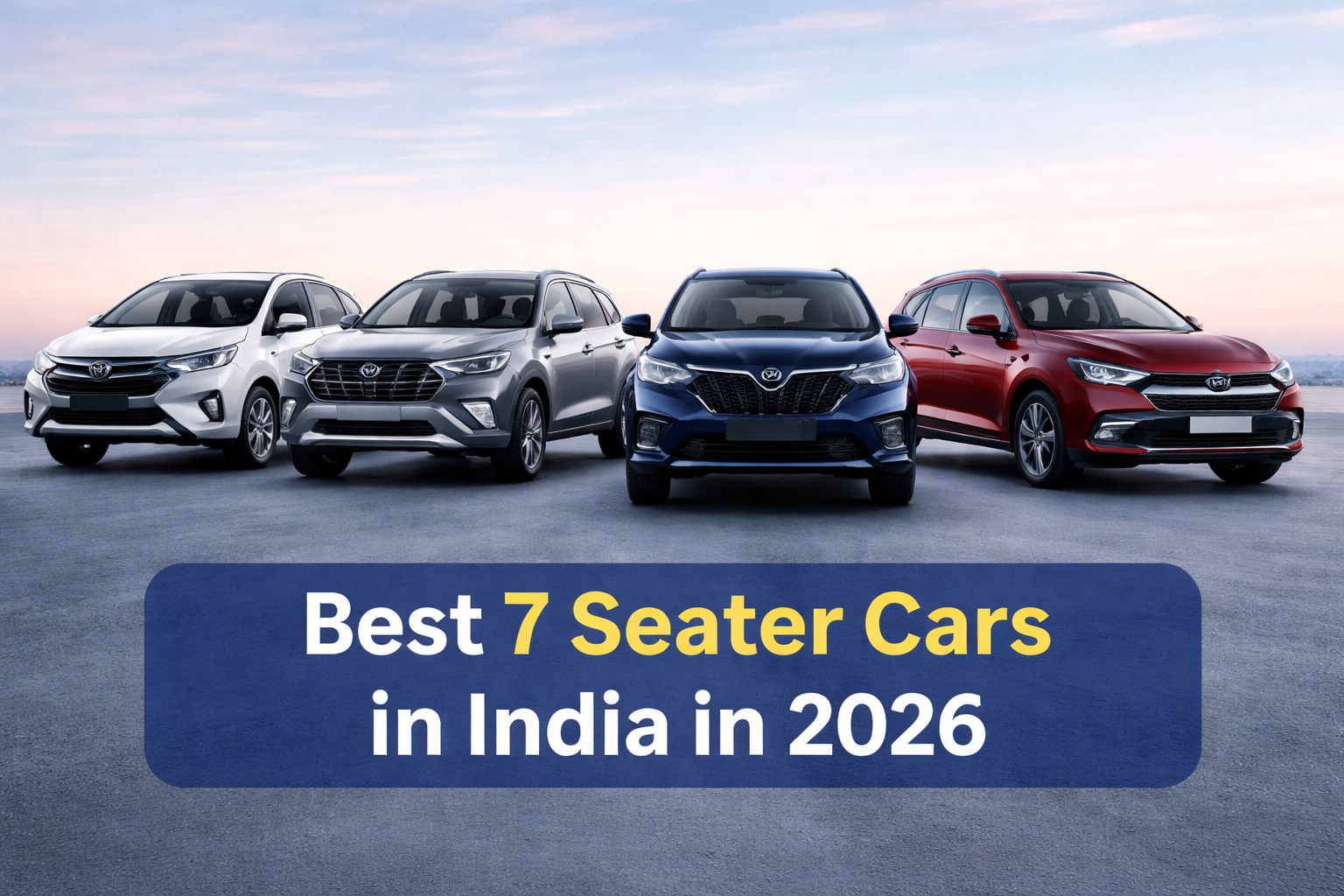
Best 7-Seater Cars in India: Explore all about the best 7-seater cars in India; know various features about the models, prices, specifications, and top-notch performance.
Best 7-Seater Cars in India 2026: Top Models, Prices & Specifications
If you are shopping for a family car that comfortably seats seven, you are spoilt for choice in 2026. From budget-friendly MPVs like the Renault Triber to flagship SUVs like the Toyota Fortuner, today's 7-seater cars in India offer better mileage, more safety features, and stronger build quality than ever before.
This guide compares the top 7-seater cars in India by price, mileage, engine, body type, and Global NCAP safety rating. It also explains how car insurance differs for a 7-seater vehicle and the add-ons that matter most. All ex-showroom prices below are indicative as on April 2026 and are subject to change without notice.
Top 7-Seater Cars in India 2026 — Comparison Table
The table below summarises the most popular 7-seater cars in India in 2026, ranked from most affordable to most premium.
Model | Ex-showroom price | Approximate on-road price | Mileage (km/l) | Engine | Body type | Global NCAP rating |
|---|---|---|---|---|---|---|
Renault Triber | ₹6.00 – 9.00 lakh | ₹7.20 – 10.60 lakh | 18.2 – 20.0 | 1.0L petrol | MPV | 4-star |
Mahindra Bolero | ₹9.79 – 10.49 lakh | ₹11.50 – 12.80 lakh | 16.0 | 1.5L diesel | SUV | Not rated |
Maruti Suzuki Ertiga | ₹8.80 – 13.08 lakh | ₹10.20 – 15.50 lakh | 20.5 (petrol) / 26.1 (CNG) | 1.5L petrol / CNG | MPV | 1-star |
Kia Carens | ₹10.99 – 19.45 lakh | ₹13.00 – 22.50 lakh | 16.0 – 21.3 | 1.5L petrol / 1.4L turbo / 1.5L diesel | MPV | 3-star |
Mahindra XUV700 | ₹13.99 – 26.99 lakh | ₹16.50 – 30.00 lakh | 13.0 – 16.0 | 2.0L petrol / 2.2L diesel | SUV | 5-star |
Mahindra Scorpio N | ₹13.99 – 24.54 lakh | ₹16.20 – 28.50 lakh | 14.0 – 16.0 | 2.0L petrol / 2.2L diesel | SUV | 5-star |
Tata Safari | ₹15.49 – 27.34 lakh | ₹17.80 – 30.20 lakh | 14.0 – 16.1 | 2.0L diesel | SUV | 5-star |
Hyundai Alcazar | ₹14.99 – 22.99 lakh | ₹17.50 – 26.50 lakh | 14.5 – 20.4 | 2.0L petrol / 1.5L diesel | SUV | Not rated |
MG Hector Plus | ₹17.59 – 23.16 lakh | ₹20.50 – 27.00 lakh | 13.4 – 17.4 | 1.5L petrol / 2.0L diesel | SUV | Not rated |
Toyota Innova Hycross | ₹19.94 – 30.66 lakh | ₹23.00 – 35.00 lakh | 21.1 (hybrid) | 2.0L hybrid petrol | MPV | 5-star |
Toyota Fortuner | ₹33.69 – 51.84 lakh | ₹40.20 – 59.50 lakh | 10.0 – 14.0 | 2.7L petrol / 2.8L diesel | SUV | 5-star (ANCAP) |
Source: Manufacturer websites, accessed April 2026. Prices are indicative ex-showroom Delhi and exclude registration, road tax, insurance, and dealer charges. Mileage figures are ARAI-claimed except where noted.
Best 7-Seater Cars Under ₹10 Lakh in India
If your budget caps at ₹10 lakh ex-showroom, your realistic 7-seater options are limited but practical: the Renault Triber, the Mahindra Bolero, and the base petrol/CNG variants of the Maruti Suzuki Ertiga.
Renault Triber (from ₹6.00 lakh) — the cheapest 7-seater car in India, with modular seating and a frugal 1.0L petrol engine.
Mahindra Bolero (from ₹9.79 lakh) — a no-frills, rugged SUV ideal for tier-2/tier-3 city use and rural roads.
Maruti Suzuki Ertiga base petrol (from ₹8.80 lakh) — the most refined and fuel-efficient choice in the segment, also available as CNG from approximately ₹9.95 lakh.
Best 7-Seater Cars Under ₹15 Lakh in India
In the ₹10–15 lakh range you unlock far more comfort and tech. The standout choices are the Kia Carens, the top Ertiga variants, the entry trims of the Mahindra Scorpio N and XUV700, and the early Tata Safari trims.
Kia Carens (from ₹10.99 lakh) — premium MPV with three engine options, ventilated front seats, and a 3-star Global NCAP rating.
Mahindra Scorpio N base diesel (from ₹13.99 lakh) — a 5-star Global NCAP SUV with proper 4×4 capability in higher trims.
Mahindra XUV700 (from ₹13.99 lakh) — feature-rich SUV with ADAS in higher trims and a 5-star Global NCAP rating.
Best 7-Seater Cars Under ₹20 Lakh in India
This is the sweet-spot for family buyers who want a fully-loaded 7-seater. Options include the Tata Safari, Hyundai Alcazar, MG Hector Plus, and the entry trims of the Toyota Innova Hycross.
Tata Safari (from ₹15.49 lakh) — strong 5-star NCAP rating, panoramic sunroof, and refined diesel-only line-up.
Hyundai Alcazar (from ₹14.99 lakh) — premium cabin, ventilated seats, and dual 10.25-inch displays.
MG Hector Plus (from ₹17.59 lakh) — segment-leading 14-inch touchscreen and ADAS in higher trims.
Best 7-Seater SUVs in India 2026
If you specifically want an SUV body type — high ground clearance, butch styling, optional 4×4 — these are the best 7-seater SUVs in India in 2026:
Model | Starting price | Drive type | Top trim Global NCAP | Why it stands out |
|---|---|---|---|---|
Mahindra Scorpio N | ₹13.99 lakh | RWD / 4×4 | 5-star | Genuine 4×4 capability with 5-star safety |
Mahindra XUV700 | ₹13.99 lakh | FWD / AWD | 5-star | Best-in-class ADAS suite at this price |
Tata Safari | ₹15.49 lakh | FWD only | 5-star | 5-star NCAP, premium cabin, diesel-only refinement |
Hyundai Alcazar | ₹14.99 lakh | FWD only | Not rated | Refined ride and family-friendly cabin |
Toyota Fortuner | ₹33.69 lakh | RWD / 4×4 | 5-star (ANCAP) | Bullet-proof build quality and resale value |
Best Mileage 7-Seater Cars in India
Among 7-seater cars in India, hybrid and CNG powertrains deliver the highest real-world fuel efficiency:
Toyota Innova Hycross (hybrid) — 21.1 km/l ARAI; the most fuel-efficient 7-seater in India.
Maruti Suzuki Ertiga CNG — 26.1 km/kg; the most economical to run on a per-kilometre basis.
Renault Triber petrol — 18.2 – 20.0 km/l; the most affordable petrol 7-seater.
Maruti Suzuki Ertiga petrol (smart-hybrid) — 20.5 km/l; the highest-mileage non-hybrid petrol option.
Best 7-Seater CNG Cars in India
If you are looking specifically for CNG-powered 7-seater cars in India, two models dominate the category:
Maruti Suzuki Ertiga S-CNG — factory-fitted twin-cylinder CNG kit, 26.1 km/kg ARAI.
Renault Triber CNG (planned for 2026 launch in select states) — to be confirmed by Renault closer to launch.
As of April 2026, the Ertiga S-CNG remains the only on-sale, manufacturer-fitted 7-seater CNG car in India.
Detailed Look at the Best 7-Seater Cars in India 2026
Renault Triber — ₹6.00 – 9.00 lakh (MPV)
The Renault Triber is the most affordable 7-seater car in India in 2026. Its modular EasyFix seating lets you fold and rearrange the third row to free up boot space when needed.
It is powered by a 1.0L three-cylinder petrol engine producing 71 bhp, paired with manual or AMT transmission. ARAI-rated mileage is 18.2 – 20.0 km/l.
Key features: 8-inch touchscreen, four airbags, ABS with EBD, ISOFIX, and a 4-star Global NCAP rating for adult occupant protection — exceptional for the price.
Mahindra Bolero — ₹9.79 – 10.49 lakh (SUV)
The Mahindra Bolero is a rugged, no-nonsense SUV built to easily handle tough Indian roads. It is powered by a 1.5L mHawk75 diesel engine paired with a 5-speed manual transmission.
Bolero is a sensible pick for tier-2 and tier-3 buyers who prioritise durability, easy maintenance, high ground clearance, and a tall stance over creature comforts.
Maruti Suzuki Ertiga — ₹8.80 – 13.08 lakh (MPV)
The Ertiga is the value-for-money champion in the 7-seater segment. Its 1.5L K-series petrol engine with smart-hybrid technology returns 20.5 km/l ARAI; the S-CNG variant offers low running costs at 26.1 km/kg.
It comes with six airbags as standard from MY2025 onwards, electronic stability control, hill-hold assist, and a 7-inch SmartPlay infotainment system with wireless Apple CarPlay and Android Auto.
Kia Carens — ₹10.99 – 19.45 lakh (MPV)
The Kia Carens is a modern, feature-rich 7-seater MPV with three engine choices (1.5L petrol, 1.4L turbo-petrol, 1.5L diesel) and a 3-star Global NCAP rating.
Highlights include dual 10.25-inch displays, ventilated front seats, six airbags, and a panoramic sunroof in Luxury Plus trim.
Mahindra Scorpio N — ₹13.99 – 24.54 lakh (SUV)
The Scorpio N blends rugged SUV character with modern comfort. It comes with a 2.0L mStallion petrol or 2.2L mHawk diesel, manual or 6-speed automatic, and rear-wheel drive (4×4 in higher trims).
Inside, you get a 9-inch touchscreen, Sony 12-speaker audio, six airbags, hill-hold and hill-descent control, and a 5-star Global NCAP rating.
Mahindra XUV700 — ₹13.99 – 26.99 lakh (SUV)
The XUV700 is one of the most feature-loaded 7-seater SUVs in India for the price. It offers Level-2 ADAS (Advanced Driver Assistance Systems), dual 10.25-inch displays, and AdrenoX connected-car tech.
Engine options include a 2.0L turbo-petrol (200 bhp) and a 2.2L diesel (155 / 185 bhp), with manual or 6-speed automatic transmission. Global NCAP awards it a 5-star rating.
Tata Safari — ₹15.49 – 27.34 lakh (SUV)
The 2026 Tata Safari carries a 2.0L Kryotec diesel engine and is now offered with manual or 6-speed automatic transmission. It scores a full 5-star rating from Global NCAP for both adult and child occupant protection.
Premium features include a panoramic sunroof, a 12.3-inch touchscreen, ventilated front seats, multiple drive modes, and Level-2 ADAS in the top trim. A Tata Safari EV is expected later in 2026.
Hyundai Alcazar — ₹14.99 – 22.99 lakh (SUV)
The Hyundai Alcazar is the 7-seater extension of the Creta and shares its mechanicals — 2.0L petrol (159 bhp) and 1.5L diesel (115 bhp) options. Top trims add a panoramic sunroof, ventilated front seats, and dual 10.25-inch displays.
Safety kit includes six airbags, ESC, hill-hold assist, and Level-2 ADAS in the Signature trim.
MG Hector Plus — ₹17.59 – 23.16 lakh (SUV)
The 2026 MG Hector Plus refresh adds a 14-inch portrait touchscreen, a panoramic sunroof, and an updated ADAS suite. It seats six or seven depending on trim and is offered with petrol or diesel powertrains.
It is positioned for buyers who want a tech-rich cabin and relaxed long-distance cruising over outright agility.
Toyota Innova Hycross — ₹19.94 – 30.66 lakh (MPV)
The Innova Hycross is the most fuel-efficient 7-seater car in India, returning 21.1 km/l ARAI thanks to its 2.0L hybrid petrol powertrain. It is rated 5-star by Bharat NCAP — India's official car safety rating program.
Premium features include dual-zone climate control, ventilated captain seats, a 10.1-inch touchscreen, and Level-2 ADAS in the ZX(O) trim.
Toyota Fortuner — ₹33.69 – 51.84 lakh (SUV)
The Fortuner remains the most aspirational 7-seater SUV in India for buyers who value bullet-proof build quality and strong resale. It offers a 2.7L petrol or 2.8L diesel, with manual, automatic, or 4×4 options.
Standard kit now includes seven airbags, vehicle stability control, hill-start assist, downhill assist control, and 360-degree cameras in the Legender and GR-Sport trims.
Difference Between a 7-Seater MPV and a 7-Seater SUV
Both body types seat seven, but they prioritise different things:
Parameter | 7-Seater MPV (e.g., Ertiga, Carens, Innova Hycross) | 7-Seater SUV (e.g., Scorpio N, XUV700, Safari) |
|---|---|---|
Primary purpose | Family transport, ride comfort, fuel economy | Highway poise, off-road ability, road presence |
Ground clearance | Lower (160 – 185 mm) | Higher (190 – 220 mm) |
Cabin layout | Flat floor, 2+2+3 or captain seats | Stepped floor, often 2+3+2 |
Mileage | Generally higher | Generally lower (especially in petrol) |
Best suited for | Daily city + occasional highway runs | Frequent highway and rough-road usage |
Factors to Consider Before Buying a 7-Seater Car
Purpose of purchase: Family transport, occasional outstation use, or commercial requirement?
Fuel type: Choose among petrol, diesel, CNG, hybrid, or electric — based on your annual running and fuel-station access.
Budget: Look at the on-road price, not the ex-showroom price; insurance and registration can add 10 – 12%.
Third-row space: A frequently overlooked factor — measure legroom and headroom for adult passengers, not just children.
Safety features: Six airbags, ESC, ABS with EBD, ISOFIX, and a Global NCAP / Bharat NCAP rating of 4-star or higher.
Service network: Especially important for diesel and hybrid vehicles in tier-2 / tier-3 cities.
How Car Insurance Differs for 7-Seater Cars
Insuring a 7-seater car is different from insuring a 5-seater on a few important points. Car insurance premiums are typically 10 – 25% higher, primarily because of the following factors:
Owner-driver Personal Accident (PA) cover of ₹15 lakh is mandatory under IRDAI rules. Unnamed Passenger PA cover is optional but strongly recommended for 7-seaters, given the higher number of occupants.
Third-party premium slabs are tiered by engine capacity: <1,000cc, 1,000–1,500cc, and >1,500cc. Most 7-seater SUVs fall in the highest slab.
Larger vehicles cause more third-party damage in an accident, raising third-party liability exposure for insurers.
Repair and spare-part costs for SUVs and MPVs are typically higher than for hatchbacks or compact sedans.
Advanced safety tech such as ADAS sensors, 360-degree cameras, and panoramic sunroofs reduce accident risk but increase repair costs when damaged.
All covers and add-ons are subject to policy terms, conditions, and exclusions. Read the product brochure carefully before concluding a sale.
Add-Ons & Features for 7-Seater Car Insurance
Standard own-damage cover only goes so far. The following add-ons are particularly relevant for 7-seater cars:
Zero-Depreciation Cover: Settles claims at full part value with no depreciation deduction — recommended for cars up to 5 years old.
Engine & Gearbox Protection: Covers internal mechanical and electrical damage to the engine and gearbox, including damage from waterlogging and oil leakage — typically excluded from standard policies.
Unnamed Passenger PA Cover: Provides accidental injury and death cover for all six passengers in addition to the mandatory owner-driver cover.
Roadside Assistance: 24/7 help for breakdowns, towing, flat tyres, and on-road emergencies — especially valuable on long family road trips.
Consumables Cover: Includes nuts, bolts, lubricants, brake oil, and other items normally excluded.
Return to Invoice Cover: In a total-loss or theft claim, pays the full invoice value of the car (not the depreciated IDV).
Tyre Protection Cover: Pays for repair or replacement of damaged tyres and tubes — heavy 7-seaters are tougher on tyres than hatchbacks.
Key Replacement Cover: Covers the cost of replacing lost or stolen smart keys.
No Claim Bonus (NCB) Protection: Lets you make a claim during the policy period without losing your accumulated NCB at renewal.
Personal Belongings Cover: Compensates for theft of or damage to personal items inside the car.
How to Compare Insurance Quotes for 7-Seater Cars
Collect multiple quotes — request estimates from at least three insurers.
Check coverage — ensure the IDV and Unnamed Passenger PA cover are correctly captured for all seven seats.
Review add-ons — pick zero-depreciation, roadside assistance, and engine protection at minimum for SUVs.
Compare premiums — assess them against IDV, claim settlement ratio, and add-on inclusions, not just the headline number.
Evaluate the claim process — research claim settlement ratio, average TAT (turnaround time), and customer reviews.
Confirm transparency — check for hidden charges, exclusions, voluntary deductibles, and surveyor-assignment policies.
Tips to Lower Your 7-Seater Insurance Premium
Compare policies across insurers using a single quote tool.
Opt for a higher voluntary deductible — pay small claims yourself in exchange for a lower premium.
Install certified anti-theft devices (ARAI-approved) for an immediate premium discount.
Choose only the add-ons that fit your driving pattern; do not over-insure.
Maintain a clean driving record so you retain the No Claim Bonus (NCB) at renewal.
Service your car at authorised workshops on schedule — well-maintained cars file fewer claims.
Discounts and premium reductions are subject to insurer underwriting and may vary.
Conclusion
In 2026, the best 7-seater car for you depends on three things: your budget, your usage pattern, and your priority — comfort, mileage, or safety. The Renault Triber and Mahindra Bolero remain the only true sub-₹10-lakh choices; the Ertiga and Carens dominate the under-15-lakh space; and the Mahindra XUV700, Tata Safari, and Toyota Innova Hycross are the all-rounders above ₹15 lakh.
Whichever 7-seater you choose, protect it with comprehensive car insurance that includes Unnamed Passenger PA cover, zero-depreciation, and engine protection.
Ready to Renew Your Car Insurance? Get a Free Quote in 2 Minutes
Frequently Asked Questions
Which is the best 7-seater car to buy in India in 2026?
The best 7-seater depends on your budget. Top picks in 2026 include the Maruti Suzuki Ertiga (under ₹15 lakh), the Mahindra XUV700 and Tata Safari (under ₹25 lakh), and the Toyota Innova Hycross (under ₹35 lakh).
Which is the cheapest 7-seater car in India?
The Renault Triber is the cheapest 7-seater car in India, starting at approximately ₹6.00 lakh ex-showroom.
Which 7-seater SUV provides the best safety and mileage?
The Toyota Innova Hycross (hybrid, 21.1 km/l, 5-star Bharat NCAP) and the Mahindra XUV700 / Tata Safari (5-star Global NCAP, 14–16 km/l) are the strongest combinations of safety and mileage.
What are the most affordable 7-seater cars under ₹10 lakh?
Renault Triber (₹6.00 – 9.00 lakh), Mahindra Bolero (₹9.79 – 10.49 lakh), and base trims of the Maruti Suzuki Ertiga (from ₹8.80 lakh) are the only mainstream options under ₹10 lakh ex-showroom.
Are there 7-seater cars under ₹15 lakh?
Yes — the Maruti Suzuki Ertiga, Kia Carens, Mahindra Scorpio N (base diesel), and Mahindra XUV700 (base trim) are all available under ₹15 lakh ex-showroom in 2026.
Which 7-seater car gives the best mileage in India?
The Toyota Innova Hycross delivers the highest ARAI-rated mileage among petrol-hybrid 7-seaters (21.1 km/l). On a per-kilometre cost basis, the Maruti Suzuki Ertiga S-CNG (26.1 km/kg) is the most economical.
Which 7-seater CNG cars are available in India?
As of April 2026, the Maruti Suzuki Ertiga S-CNG is the only 7-seater car in India offered with a factory-fitted CNG kit.
What is the difference between an MPV and an SUV 7-seater?
An MPV (Multi-Purpose Vehicle) is built for ride comfort, family practicality, and fuel economy. An SUV (Sport Utility Vehicle) prioritises higher ground clearance, off-road ability, and a stronger road presence. MPVs typically offer better mileage; SUVs offer better highway and rough-road capability.
Does a 7-seater cost more to insure than a 5-seater?
Yes. Premiums are typically 10 – 25% higher because of the larger engine slab, higher repair costs, and the cost of optional Unnamed Passenger PA cover for the additional two seats.
Is third-party car insurance enough for a 7-seater car?
Third-party car insurance is the legal minimum, but it does not cover damage to your own car. A comprehensive policy with zero-depreciation, engine protection, and Unnamed Passenger PA cover is strongly recommended for 7-seaters.
Can I insure a family 7-seater for commercial use?
If your 7-seater is used commercially (taxi, ride-share, tourist transport), you must declare commercial use and purchase a commercial passenger-carrying vehicle policy. Insuring it as a private car and using it commercially can lead to claim rejection.
How do safety features affect my insurance premium?
Certified safety devices (anti-theft alarms, AIS-145 compliance) can earn discounts at the time of buying. However, premium safety tech such as ADAS, 360-degree cameras, and panoramic sunroofs increase repair costs, which can raise your renewal premium if you make a claim.
Related Insurance Guides:-
Explore more on car insurance
Easy access to more, check out these quick links



Get Quick Quote