
Key Takeaways
|
Imran Sheikh collected a new hatchback in Hyderabad last week. The dealer’s insurance desk pushed zero depreciation hard and he took the quote home to think. His car is new, so he assumes nothing has depreciated yet. He wants to know what the add-on would do for him this year.
That assumption is half right, and the half that is wrong decides the answer. Some parts on his car are cut by half from the day he drove it out. Others are not cut at all for six months.
What is the difference between comprehensive and zero depreciation car insurance?
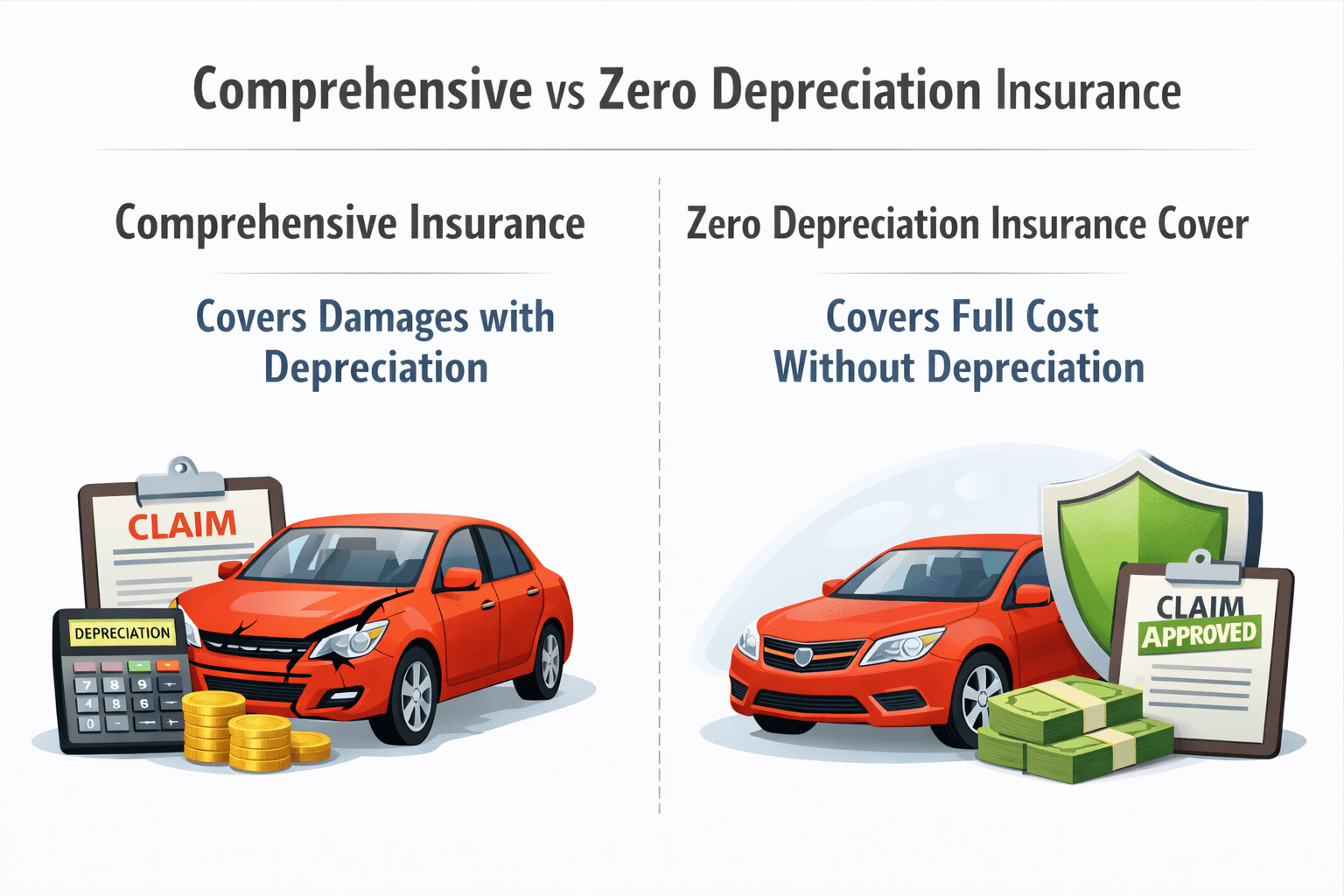
Comprehensive is the policy. Zero depreciation is an optional add-on you buy on top of it. The policy covers damage to your own car, third-party liability and theft. The add-on changes one thing about how a claim is settled. It removes the cut the insurer takes off each replaced part.
The two are not alternatives, so the choice is never one or the other. You cannot buy zero depreciation on its own. It attaches to a comprehensive policy and has no existence without one.
Zurich Kotak files the add-on as Depreciation Cover under its Car Secure policy. You will also see it sold as nil depreciation, zero dep and bumper-to-bumper cover. The last of those names oversells it, since the add-on works on depreciation and nothing else.
What does comprehensive car insurance cover?
A comprehensive policy covers damage to your own car from accident, fire, theft and natural events. It carries the third-party liability cover the law requires. It also carries Compulsory Personal Accident cover for the owner-driver at ₹15 lakh. Add-ons sit on top of that base.
Own damage is the part of the policy that pays to repair your own car. That side is where depreciation lives. When you claim for repairs, the insurer approves the bill. It then takes a percentage off each replaced part. You pay that share, along with your deductible.
Third-party cover works differently and no depreciation touches it. Those rates are fixed by notification, so no insurer discounts or loads them. Comparing quotes on that part of the premium is wasted effort.
What does zero depreciation cover add to a comprehensive policy?
The add-on stops the insurer deducting depreciation on parts replaced during a repair. Parts are paid for in full, and what you pay is your deductible. It changes nothing about which parts are approved, and nothing about theft or a write-off.
Those last two points are the ones people miss. The add-on acts on the cut applied to replaced parts. A claim where nothing is replaced gives it nothing to act on.
So a theft claim or a write-off is settled on your insured value, with or without the add-on. The money you paid for it does nothing in either case. It works on repairs.
How much does depreciation take off a comprehensive car insurance claim?
Plastic, rubber, nylon, tyres, tubes, batteries and airbags are cut by 50% at any age. Fibreglass is cut by 30% and glass is not cut at all. Metal parts follow the car’s age, starting at nothing under six months and reaching 50% past ten years.
Cuts that stay the same whatever the car’s age
Type of part | Cut applied |
|---|---|
Rubber, nylon and plastic parts | 50% |
Tyres and tubes | 50% |
Batteries | 50% |
Airbags | 50% |
Fibreglass parts | 30% |
Glass parts | Nil |
Painting | 50% on material, material taken as 25% of a combined bill |
Cuts on metal parts, by the age of the car
Age of the car | Cut applied |
|---|---|
Not exceeding 6 months | Nil |
Over 6 months to 1 year | 5% |
Over 1 year to 2 years | 10% |
Over 2 years to 3 years | 15% |
Over 3 years to 4 years | 25% |
Over 4 years to 5 years | 35% |
Over 5 years to 10 years | 40% |
Over 10 years | 50% |
Read those two tables together and the shape of the add-on appears. On a brand-new car the metal column gives you nothing at all. The 50% column gives you half the cost of every plastic panel and airbag on the car.
Modern cars are full of that second category. Bumpers, cladding, lamp units and dashboard trim are all plastic. They are also the parts a city car damages first.
Comprehensive vs zero depreciation: a worked claim on a new car
On a ₹53,000 front-end repair to an eight-month-old car, a comprehensive policy pays ₹35,300 after the deductible. With zero depreciation cover you receive ₹52,000. The gap is ₹16,700, and ₹15,000 of it comes from two plastic parts.
A ₹53,000 front-end repair on an 8-month-old car
Item on the repair bill | Cost | Cut applied | Paid without the add-on | Paid with the add-on |
|---|---|---|---|---|
Front bumper, plastic | ₹12,000 | 50% | ₹6,000 | ₹12,000 |
Headlamp assembly, plastic | ₹18,000 | 50% | ₹9,000 | ₹18,000 |
Bonnet, metal | ₹9,000 | 5% | ₹8,550 | ₹9,000 |
Painting, combined bill | ₹10,000 | 50% on 25% of the bill | ₹8,750 | ₹10,000 |
Labour | ₹4,000 | Nil | ₹4,000 | ₹4,000 |
Approved total | ₹53,000 | ₹36,300 | ₹53,000 | |
Less your deductible | ₹1,000 | ₹1,000 | ||
Amount you receive | ₹35,300 | ₹52,000 |
The bonnet is the line to look at twice. It is the most expensive single panel in that bill at ₹9,000. The add-on rescues ₹450 of it. The two plastic parts cost half as much between them and the add-on rescues ₹15,000.
Imran’s quote covers exactly this kind of bill, which is why the plastic lines matter to him. Painting works on its own rule and catches people out. Material is taken as 25% of a combined paint bill, so ₹10,000 of paintwork gives ₹2,500 of material. The 50% cut applies to that alone, making the deduction ₹1,250.
The example assumes a ₹1,000 compulsory deductible. Motor tariff provision GR.40 sets that by engine capacity. It is ₹1,000 up to 1,500 cc and ₹2,000 above. Your own schedule prints the figure that applies to your car. Rework the sums with yours.
What does zero depreciation cover not pay for?
The add-on removes depreciation on replaced parts and nothing else. Your deductible still applies to every claim. Consumables are excluded. So are parts the insurer has not approved for replacement. So is anything already covered by a warranty or a recall.
Three exclusions sit in the wording. The first covers any part the insurer has not approved for replacement. Say the assessor decides to beat and repair a panel. Then the add-on has nothing to work on. The second leaves out consumables such as nuts, bolts and grease, which Consumables Cover handles. The third rules out anything covered by a warranty, a recall campaign or another policy.
Water entering the engine or oil leaking sits outside both the base policy and the add-on. Engine Protect is the cover for that, and it matters in flood-prone cities. Mechanical breakdown and ordinary wear are outside both as well.
Then there is the ceiling nobody mentions. Your car is written off once the repair bill passes 75% of its insured value. Above that line nothing is replaced, so the add-on pays nothing at all.
How can you reduce the cost of zero depreciation cover?
You can choose a voluntary deductible under the add-on, at ₹1,000, ₹2,000 or ₹3,000. That cuts the add-on premium by up to 10%, 15% or 20%, capped at ₹500, ₹750 and ₹1,000. In return you pay that amount on every claim you make under the add-on.
Voluntary deductible options under Depreciation Cover
Deductible you choose | Discount on the add-on premium | Most you can save | You pay on each claim |
|---|---|---|---|
₹1,000 | Up to 10% | ₹500 | ₹1,000 |
₹2,000 | Up to 15% | ₹750 | ₹2,000 |
₹3,000 | Up to 20% | ₹1,000 | ₹3,000 |
The discount is capped in rupees, so the largest of them saves you ₹1,000 and saves it once. The deductible then applies to every claim you make for the rest of the year. Take a ₹53,000 repair that would pay out ₹52,000 under the add-on. A ₹3,000 deductible brings that to ₹49,000, so you give up ₹3,000 to save ₹1,000.
The math points one way on almost every quote, so take the smallest deductible offered. Car Secure also lists a Voluntary Deductible Protect add-on, which waives your voluntary deductible at a preferred garage. That is worth asking about if the garage you would use is on the preferred list.
Is zero depreciation car insurance available after 5 years?
The Depreciation Cover wording carries three exclusions and none of them is a maximum age. It sets no age limit. The five-year limit owners run into comes from how insurers price and accept risk on older cars. That is a decision made case by case.
Insurers offer the add-on most readily in the first five years from registration. Some will look at seven or eight years on a well-kept car, after an inspection. Past that it becomes hard to find.
So a refusal is a judgement about your particular car. Nothing fires automatically on the fifth anniversary. An inspection report showing the car in good condition can help, and so can a clean claim record.
What does change with age is the money involved. The cuts get steeper, so the add-on saves more. The write-off ceiling falls with your insured value, so the window in which it can help gets narrower.
How many claims does zero depreciation cover allow?
Your policy schedule names a number of claims for damage to your own car. The add-on runs from your first such claim up to that number. Later claims in the same year get the usual cuts. That number is set on your schedule and is not fixed across the market.
This is the single most useful thing to check before comparing two quotes. One insurer may cover two claims and another three, and both will call the product zero depreciation. A cheaper quote covering fewer claims is not cheaper in any way that matters.
So find the number before you compare the price. Then compare the add-on premium alone against the same claim count. A quote that omits that number cannot be compared.
Does a zero depreciation claim affect your No Claim Bonus?
Yes. A claim under the add-on is still a claim for damage to your own car. Any such claim resets your No Claim Bonus at the next renewal. NCB Protect can hold your slab for one such claim in the period. It needs renewal within 90 days.
The bonus climbs on a fixed scale for every claim-free year. It runs from 20% after one year to 50% after five. Losing it is a real cost, and on a small claim it can exceed what the add-on recovers. A claim for glass alone does not count against you under NCB Protect.
So before filing a small claim, put three numbers side by side. What the cut would take off the bill. What your deductible comes to. And the extra premium you pay next year once the discount goes. If the second and third together approach the first, pay for the repair yourself.
Holding the add-on changes only the first of those three numbers. It does nothing about the deductible and nothing about the bonus. That is why a ₹9,000 bumper scrape is rarely worth claiming either way.
Should you buy comprehensive or zero depreciation car insurance for a new car?
Take the add-on on a new car, for the plastics rather than the metal. Bumpers, lamp units and airbags are cut by half from day one. Those are the parts a city car damages first. Check the claim count on your schedule and take the smallest voluntary deductible offered.
Imran’s answer came from the worked example rather than the dealer’s pitch. His hatchback has plastic bumpers front and rear, plastic lamp housings and six airbags. One parking-level knock to the front end puts most of the add-on’s value on the table.
The reasoning everyone gives for a new car is the wrong one. Parts do not all depreciate fast in the early years. Metal depreciates slowly and plastic depreciates instantly. So on a new car the add-on is really a plastics and airbag cover.
Comprehensive alone is the sensible choice in two situations. On a car insured below ₹1,50,000 the write-off line sits low. Serious damage crosses it, leaving the add-on nothing to do. On any car where you would absorb a ₹15,000 repair without difficulty, the premium may be better kept.
Zurich Kotak General Insurance offers Depreciation Cover under its Car Secure policy. Consumables Cover , Engine Protect and Voluntary Deductible Protect are available alongside it. A quote confirms what applies to your own car.
Car Insurance Quote
Frequently asked questions
Is zero depreciation cover the same as comprehensive insurance?
No. Comprehensive is the policy and zero depreciation is an optional add-on bought on top of it. The policy covers damage to your own car, third-party liability and theft. The add-on removes the cut the insurer takes off each replaced part during a repair.
Can I buy zero depreciation cover without comprehensive insurance?
No. The add-on attaches to a comprehensive policy and has no existence without one. Zurich Kotak files it as Depreciation Cover under the Car Secure policy.
What parts does zero depreciation cover save me money on?
Most on plastic, rubber, tyres, batteries and airbags, which are cut by 50% at any age. Least on metal parts in the early years. Those are cut by nothing for six months, then 5% to one year. Glass carries no cut either way, and labour is never cut.
How much does zero depreciation cover save on a claim?
On a ₹53,000 front-end repair to an eight-month-old car the difference is about ₹16,700. Nearly all of that comes from two plastic parts. The metal bonnet in the same bill contributes ₹450.
Does zero depreciation cover mean I pay nothing?
No. Your compulsory deductible still applies to every claim, and a voluntary deductible applies if you chose one. The add-on removes depreciation on replaced parts and leaves everything else where it was.
Is zero depreciation cover available for a car older than 5 years?
Often, though it is not guaranteed. The Depreciation Cover wording sets no maximum age and carries three exclusions, none of them about age. Offering it on an older car is the insurer’s decision, usually made after an inspection.
How many claims does zero depreciation cover allow in a year?
Your policy schedule names the number. The add-on runs from your first such claim up to that number. Later claims get the usual cuts. Check it before comparing two quotes, because one may cover two claims and another three.
Does a zero depreciation claim reset my No Claim Bonus?
Yes. Any claim for damage to your own car resets the bonus at the next renewal. NCB Protect can hold your slab for one such claim in the period. It needs renewal within 90 days. A glass-only claim does not count against you under it.
Does zero depreciation cover engine damage?
Only in part. If engine or gearbox parts are replaced after an accident, the add-on removes the cut on them. It does nothing where water enters the engine or oil leaks. The base policy excludes that too. Engine Protect is the add-on for that.
Does zero depreciation cover help on an electric car?
Yes on the parts that get cut. Batteries, plastics and tyres are all cut by 50% at any age. The traction battery that drives the car is a different matter and sits outside this add-on entirely. Battery Protect and EV Protect are the covers for the traction battery and the drive motor. EV Protect also covers the charging equipment.
Does zero depreciation cover help if my car is stolen or written off?
No. Those claims are settled on your insured value less what the wreck is worth. No parts are replaced, so the add-on has nothing to act on. It works on repairs.
Explore more on car insurance
Easy access to more, check out these quick links