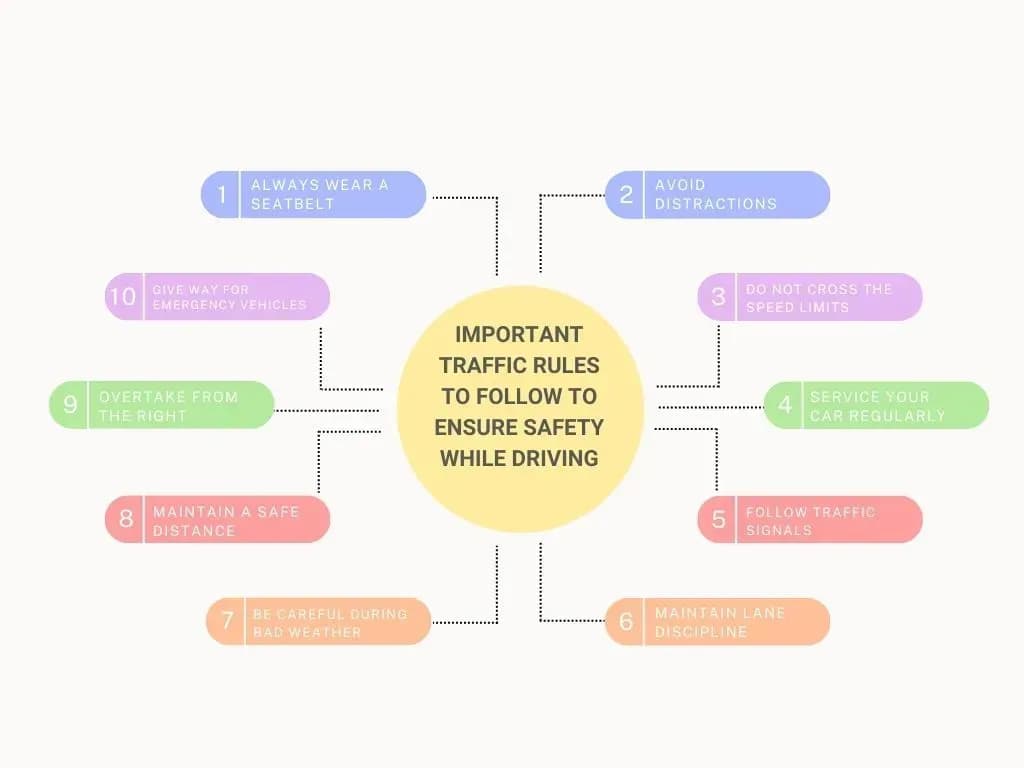
Road safety is not just a legal obligation. Every driver has a responsibility to protect their own life and the lives of others on the road. Whether you are a new driver or an experienced one, following traffic rules consistently is the single most effective way to prevent accidents.
In India, road accidents claim over 1.5 lakh lives every year, according to the Ministry of Road Transport and Highways. Simple habits like wearing a seatbelt, following speed limits, and maintaining lane discipline can make a significant difference, and so can the car itself - see which is the safest car in India , based on crash-test scores.
At Zurich Kotak, we believe that safe driving and smart car insurance coverage go hand in hand. Here are the most important road safety rules and traffic rules that every car driver in India should follow.
1. Follow All Traffic Rules and Signals
Traffic signals, road signs, and lane markings exist to maintain order and prevent collisions. Always obey red lights, stop signs, and zebra crossings. Running a red light is not only illegal under the Motor Vehicles Act, 1988 , but also one of the leading causes of intersection accidents.
● Stop fully at red lights and wait for the green signal before moving.
● Obey road signs such as speed limit boards, no-entry signs, and one-way indicators.
● Give pedestrians the right of way at zebra crossings.
2. Never Drive Under the Influence of Alcohol or Drugs
Alcohol and drugs severely impair your judgement, reaction time, and coordination; enforcement varies by city, and Delhi's traffic rules on drink-driving are among the strictest in the country. Driving with a blood alcohol concentration (BAC) above 30 mg per 100 ml of blood is a criminal offence under Section 185 of the Motor Vehicles Act, 1988. First-time offenders face a fine of up to Rs 10,000 or six months imprisonment, or both.
Never get behind the wheel after consuming alcohol, even in small amounts.
Avoid driving if you are on medication that causes drowsiness or impaired focus.
If you have been drinking, arrange for a designated driver or use a cab service.
Always drive sober to ensure better judgement, faster reaction time, and safer driving.
3. Follow Posted Speed Limits
Speeding is one of the most common causes of road accidents in India. Speed limits in India vary by road type, vehicle category, and state regulations. As a general reference under the Motor Vehicles Act:
● Cars on National Highways: 100 km/h (subject to state-level variation).
● Cars within city or municipal limits: 50 km/h.
● Cars in school zones or near hospitals: 25 km/h.
Always check the posted speed limit signs on the road you are travelling. Speeding not only increases accident risk but can also affect your car insurance claim in the event of an accident.
Speed limits vary by state and road type. Always refer to the posted signage and your state's traffic authority guidelines - see our Karnataka traffic fines and over-speeding penalties guide if you're driving there. - see our Kerala traffic fines and over-speeding penalties guide if you're driving there.
4. Maintain a Safe Following Distance
Keeping enough space between your car and the vehicle ahead gives you time to react and brake safely. A simple way to measure this is the 3-second rule: pick a fixed point on the road, and ensure at least 3 seconds pass between when the vehicle ahead crosses it and when you do.
● Increase following distance to 4-6 seconds in wet or foggy conditions.
● Maintain extra distance when driving behind heavy vehicles such as trucks and buses.
● Avoid tailgating, as it is a major cause of rear-end collisions.
5. Use Indicators and Signals Correctly
Indicating your intention to turn or change lanes well in advance gives other drivers, cyclists, and pedestrians time to respond. Always use your turn indicators before turning or changing lanes, not during or after.
● Signal at least 30 metres before a turn in residential areas.
● Signal at least 100 metres before a turn on highways.
● Use hazard lights when your vehicle is stationary on the road or during very low visibility conditions such as heavy rain or dense fog.
6. Check Blind Spots Before Changing Lanes
Your car's mirrors do not cover every angle. Blind spots are areas around your vehicle that you cannot see in your rearview or side mirrors. Always check blind spots by briefly turning your head before changing lanes or merging onto a highway.
● Adjust your mirrors correctly every time you get into the car.
● On multi-lane roads in India, always overtake from the right. Overtaking from the left on undivided roads is prohibited under the Central Motor Vehicles Rules.
● Be especially careful when larger vehicles such as trucks are nearby, as they have larger blind spots.
7. Avoid All Driver Distractions
Distracted driving is as dangerous as drunk driving. Taking your eyes off the road for just 2 seconds at 60 km/h means your car travels over 33 metres without you in full control.
● Do not use a mobile phone while driving. Using a handheld device while driving attracts a fine under the Motor Vehicles Act.
● Avoid eating, adjusting the music system, or turning to speak to passengers while the vehicle is in motion.
● If you need to make a call or check directions, pull over safely before doing so.
8. Adapt Your Driving to Weather Conditions
India experiences a wide range of weather conditions, including heavy monsoon rains, summer heat, and winter fog. The roads may become foggy during winters , so adjust your driving to suit the conditions.
● In rain: Reduce speed, increase following distance, and avoid sudden braking. Turn on headlights even during daylight if visibility is poor.
● In fog: Use low-beam headlights, not high beams. Turn on hazard lights if visibility drops severely. Pull over safely if you cannot see the road ahead.
● In heat: Check tyre pressure more frequently, as heat causes tyres to expand and can lead to blowouts.
9. Ensure Your Vehicle Is Roadworthy
A well-maintained vehicle is a safer vehicle. Regular servicing and pre-trip checks reduce the risk of mechanical failure on the road.
● Check brakes, tyres, lights, windscreens, and mirrors regularly.
● Ensure tyre tread depth meets the legal minimum and that tyres are inflated to the correct pressure.
● Replace windscreen wipers before the monsoon season.
● Ensure all lights, including indicators, brake lights, and headlights, are functional, and check that your windows meet car window tinting laws in India , since visibility compliance covers both.
10. Follow Lane Discipline
Proper lane discipline reduces congestion, prevents accidents, and keeps traffic flowing smoothly.
● Drive in the lane appropriate for your speed and destination.
● On roads with multiple lanes, use the right lane for overtaking and return to the left lane afterwards.
● On single-carriageway roads, overtaking from the left is prohibited under Indian traffic rules.
● Avoid weaving between lanes unnecessarily.
11. Drive Safely at Intersections
Intersections are among the most accident-prone locations on any road. Approach all intersections with caution, regardless of the signal in your favour.
● Slow down as you approach an intersection and be prepared to stop.
● Check for vehicles and pedestrians crossing even if you have a green light or right of way.
● At uncontrolled intersections, yield to vehicles already in the intersection and to vehicles on the right.
12. Protect Child Passengers
Children are among the most vulnerable occupants in a vehicle. Under Rule 138(3) of the Central Motor Vehicles Rules, children under 4 years of age must not be seated in the front without an approved child restraint system.
● Always use an age-appropriate child car seat or booster seat.
● Children should ideally be seated in the rear of the vehicle.
● Never hold a child on your lap while driving.
13. Avoid Driving When Fatigued
Driver fatigue is as dangerous as driving under the influence of alcohol. On long journeys, fatigue can set in within 2-3 hours and significantly slow your reaction time.
● Take a break of at least 15-20 minutes for every 2 hours of driving.
● Avoid driving between midnight and 6 am unless necessary, as drowsiness peaks during this period.
● If you feel drowsy, pull over at a safe location such as a highway rest stop and rest before continuing.
● Do not rely on caffeine or energy drinks as a long-term substitute for proper rest.
14. Prevent and Manage Road Rage
Road rage leads to aggressive driving, which endangers you and other road users. Stay calm when faced with provocation from other drivers.
● Do not engage with aggressive drivers. Avoid eye contact and do not retaliate.
● If another driver is following or threatening you, drive to the nearest police station or a busy public place.
● If you feel yourself getting angry, take a few deep breaths, slow down, and give yourself space from the trigger.
15. Wear Your Seatbelt at All Times
Wearing a seatbelt is one of the simplest and most effective road safety measures available. Under the Motor Vehicles Act, not wearing a seatbelt is a fineable offence for both the driver and front-seat passengers.
● Buckle up before starting the engine, even for very short trips.
● Ensure all rear-seat passengers also wear seatbelts.
● Children must be secured in appropriate child restraints rather than adult seatbelts alone.
16. Respect Pedestrians, Cyclists, and Other Road Users
Pedestrians and cyclists are the most vulnerable road users. Showing consideration for them reduces the risk of serious injury in the event of a collision.
● Always slow down near schools, hospitals, and pedestrian crossings.
● Give cyclists sufficient space when overtaking. Do not cut in front of them.
● If you ride a two-wheeler , always wear an ISI-marked helmet as required by the Motor Vehicles Act. Ensure your pillion rider also wears a helmet.
Read Also: Obey Traffic Rules
Road Safety and Your Car Insurance
Safe driving does more than protect lives. It also has a direct impact on your car insurance premium . Every claim-free year earns you a No Claim Bonus (NCB) on your Zurich Kotak car insurance policy, which can reduce your renewal premium by up to 50%.
● Zero accidents means zero claims, which means a lower premium at renewal.
● A clean driving record can also make you eligible for additional discounts.
● Comprehensive car insurance from Zurich Kotak covers you against accidents, theft, natural calamities, and third-party liability even when you follow all the rules and an incident still occurs.
Protect yourself and others by following these road safety rules every time you drive. And make sure your vehicle is protected with the right car insurance coverage .
Get a Car Insurance Quote in 60 seconds
FAQs: Road Safety Rules
What are the most important road safety rules in India?
The most important road safety rules include wearing a seatbelt, following speed limits, obeying traffic signals, never driving under the influence of alcohol, maintaining a safe following distance, and using turn indicators correctly. These are all mandated under the Motor Vehicles Act, 1988.
What is the speed limit for cars on highways in India?
For private cars on national highways, the general speed limit is 100 km/h. However, this varies by state and road type. Always check posted speed limit signs. Within city limits, the standard limit is 50 km/h. In school zones, the limit is typically 25 km/h.
Does safe driving affect my car insurance premium?
Yes. Safe driving directly benefits your car insurance. Every year without a claim earns you a No Claim Bonus (NCB) , which can reduce your car insurance renewal premium by up to 50% over five consecutive claim-free years.
What is the 3-second rule in driving?
The 3-second rule is a method for maintaining a safe following distance. Choose a fixed landmark on the road ahead. When the vehicle in front passes it, count three seconds. If you reach the landmark before three seconds have passed, you are too close. In adverse weather, increase this to 4-6 seconds.
Is overtaking from the left legal in India?
On undivided single-carriageway roads, overtaking from the left is prohibited under the Central Motor Vehicles Rules. On multi-lane roads and expressways, drivers should use the right lane for overtaking and return to the left lane. Always check local road rules and signage.
What should I do if my car breaks down on a highway?
If your car breaks down on a highway, move the vehicle as far to the left of the road as possible. Turn on your hazard lights immediately. Place a warning triangle behind the vehicle if available. Call for roadside assistance. Do not stand on the road itself while waiting.
How does fatigue affect driving?
Driver fatigue slows your reaction time, reduces your ability to concentrate, and increases the risk of falling asleep at the wheel. Research shows that being awake for 17-19 hours impairs driving ability to a level comparable to a blood alcohol concentration of 0.05%. Take regular breaks on long journeys.
What is the fine for using a mobile phone while driving in India?
Under the Motor Vehicles (Amendment) Act, 2019, using a handheld mobile phone while driving attracts a fine of Rs 1,000 for a first offence and Rs 2,000 for subsequent offences, along with possible suspension of the driving licence.
Can I drive my car without the original documents?
Yes. Digital versions stored in DigiLocker or mParivahan are legally accepted during traffic checks. You should ensure these include valid documents such as your driving licence, registration certificate (RC), and insurance policy, and that they are accessible whenever required by traffic authorities.
What documents should I carry while driving in India?
Every driver should carry valid documents such as their driving licence , registration certificate, insurance copy, and, where applicable, a valid Pollution Under Control (PUC) certificate. These can be carried as physical copies or as legally accepted digital documents through DigiLocker or mParivahan.
What happens if I break a traffic rule?
Breaking traffic rules can result in fines, licence suspension , penalty points, or other legal action depending on the nature of the offence. Following traffic rules helps keep you safe and avoids unnecessary penalties.
Explore more on car insurance
Easy access to more, check out these quick links