
image

Created on:

21 May 2026

Last Updated on:

21 May 2026

Learn the truth behind common traffic rule myths in India, including seat belt laws, mobile phone usage, overtaking, wrong-side driving, parking rules, drunken driving limits, and mandatory motor insurance under the Motor Vehicles Act, 1988.

8 Common Myths About Indian Traffic Rules: What the Law Actually Says

Last updated: May 2026  |  Reviewed by the Zurich Kotak Motor Insurance team

India has one of the highest road-accident burdens in the world. According to the Ministry of Road Transport and Highways' Road Accidents in India 2022 report, the country recorded over 4.6 lakh road accidents and 1.68 lakh deaths in a single year, which works out to one road-accident death roughly every 3.4 minutes. A large share of these accidents is preventable. Below, we list eight common myths about Indian traffic rules and the actual position under the Motor Vehicles Act, 1988 (as amended in 2019), with the fines that apply for each violation.

Stay road legal and financially protected. Get a quote for car or two-wheeler insurance at zurichkotak.com or call 1800 2120 (toll free).

Myth 1: Traffic Lights Can Be Ignored at Night

Fact: Traffic signals are in force 24 hours a day, 365 days a year. They operate even when no traffic constable is present at an intersection.

A red signal means stop, regardless of the time of day or the lack of traffic. Some intersections show a blinking amber light at night, which means slow down and proceed with caution after checking for cross traffic. Jumping a signal is an offence under Section 184 of the Motor Vehicles Act, 1988, and attracts a fine of Rs. 1,000 for the first offence and Rs. 2,000 for a repeat offence in most states.

Myth 2: It Is Fine to Reverse on a One-Way Road

Fact: Driving against the flow on a one-way road is illegal, irrespective of whether you are moving forward or in reverse.

What matters in law is the direction of traffic flow, not the direction your vehicle is facing. Wrong-side driving is treated as dangerous driving under Section 184 of the Motor Vehicles Act, 1988 and can attract a fine of Rs. 1,000 to Rs. 5,000 for the first offence, with up to Rs. 10,000 and one year in prison for a repeat offence.

Myth 3: You Can Overtake From the Left

Fact: Overtaking in India must be done from the right side of the vehicle in front.

Overtaking from the left is permitted only in two limited situations. First, when the driver ahead has signalled a right turn and is moving to the right. Second, on multi-lane roads where the vehicle in the right lane is moving slower than the traffic in the left lane (passing on the left is allowed in this case but is not legally treated as overtaking). Always use your indicator before changing lanes, and avoid overtaking on bridges, turns, intersections and zebra crossings. Improper overtaking can attract a fine of Rs. 1,000 to Rs. 2,000 under Section 184.

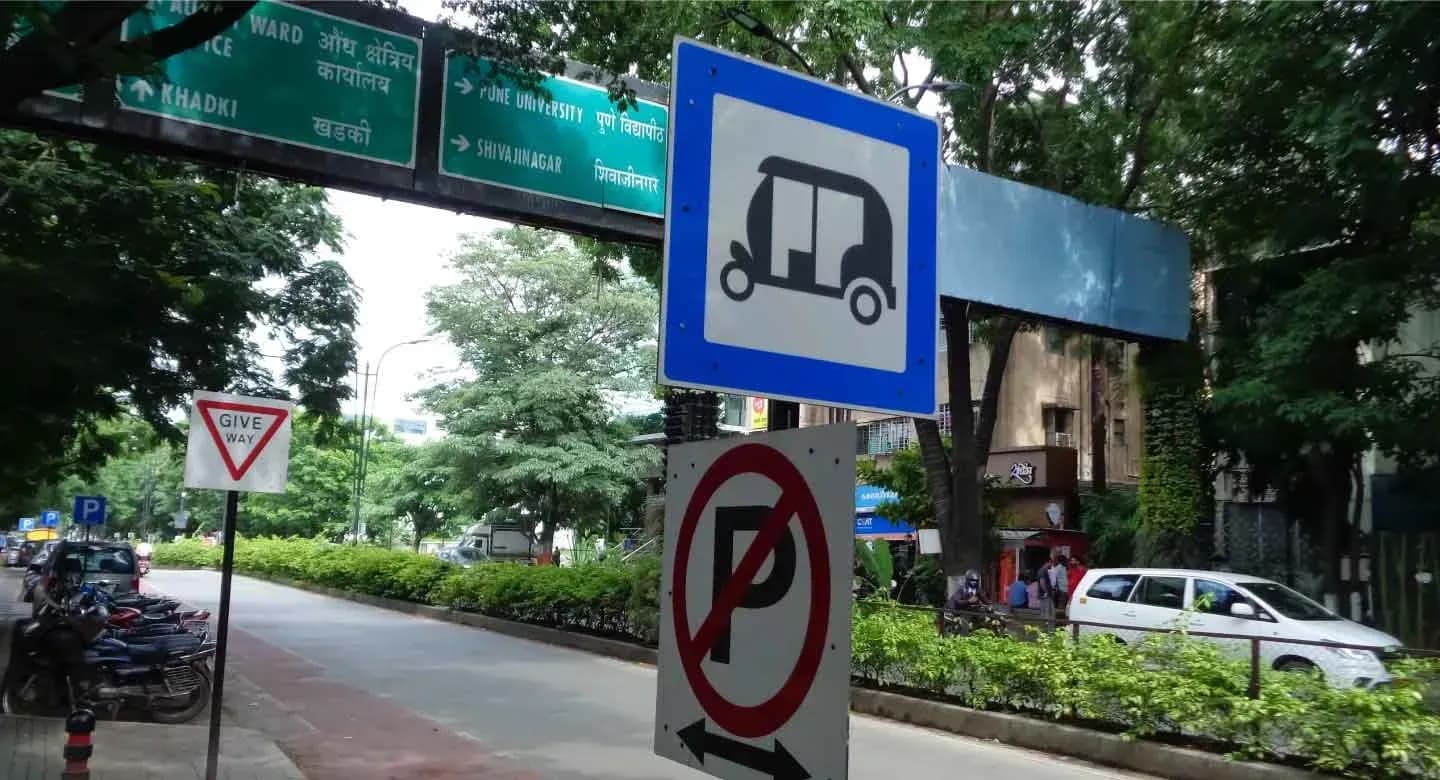
Myth 4: Any Empty Spot Is a Parking Space

Fact: Parking is only permitted in designated parking areas. A No Parking sign, a fire hydrant, a bus stop or a hospital entrance is never a legal parking spot.

Wrong parking obstructs traffic, blocks emergency access and attracts a fine of Rs. 500 for the first offence and Rs. 1,500 for a repeat offence under Section 177A of the Motor Vehicles Act. The vehicle can also be towed at the owner's expense, and the towing fee plus the storage fee is recovered before the vehicle is released.

Myth 5: You Do Not Need a Seat Belt for Short Drives or Slow Driving

Fact: Seat belts are mandatory for all occupants of a car, including rear-seat passengers, on every drive.

According to the World Health Organization, seat belts reduce the risk of death for front-seat occupants by about 45 percent and the risk of serious injury by about 50 percent. For rear-seat passengers, the risk reduction is about 25 percent. Driving or riding in a car without a seat belt attracts a fine of Rs. 1,000 under Section 194B of the Motor Vehicles Act (as amended in 2019). The rule applies whether you are driving across the city or only a few hundred metres.

Myth 6: High Beam Headlights Can Be Used Anywhere

Fact: High beam (full beam) headlights are meant for unlit highways and rural roads. They must not be used inside city limits or when there is oncoming traffic.

High beam glare causes momentary blindness in oncoming drivers and is a recognised cause of head-on accidents. Switch to low beam (dipped beam) within 200 metres of an oncoming vehicle, in well-lit city roads and when following another vehicle closely. Improper use of high beam can attract a fine under local traffic rules and is treated as rash driving in serious cases.

Myth 7: A Hands-Free Mobile Phone Is Safe While Driving

Fact: Any use of a mobile phone for voice calls, texting or social media while driving is treated as a distraction and is punishable, even if the phone is hands-free.

Under Section 184 of the Motor Vehicles Act (as amended in 2019), using a mobile phone while driving attracts a fine of Rs. 5,000 for the first offence and Rs. 10,000 for a repeat offence. The use of a phone for navigation is permitted (as per the new Motor Vehicle Rules from 1 October 2020), as long as it does not distract the driver. If you must take a call, pull over to a safe location, switch on hazard lights and then answer.

Myth 8: An Old Car Does Not Need Motor Insurance

Fact: Motor insurance is mandatory for every vehicle on a public road in India, regardless of how old the vehicle is.

Under Section 146 of the Motor Vehicles Act, 1988, every vehicle must carry at least a valid third party liability insurance policy. The age of the vehicle does not change this requirement. Driving without valid insurance is punishable with a fine of Rs. 2,000 for the first offence and Rs. 4,000 for a repeat offence under Section 196, and the vehicle can be impounded. For older vehicles, a third party policy is the legal minimum; a comprehensive policy is recommended to cover own damage, theft and natural calamities.

Quick Reference: Common Traffic Fines in India (Motor Vehicles Amendment Act, 2019)

Offence

First Offence

Repeat Offence

Driving without a valid licence

Rs. 5,000

Rs. 10,000

Driving without insurance

Rs. 2,000

Rs. 4,000

Riding without helmet (rider and pillion)

Rs. 1,000 + 3 months DL suspension

Rs. 1,000

Driving without seat belt

Rs. 1,000

Rs. 1,000

Speeding (light motor vehicle)

Rs. 1,000 to Rs. 2,000

Rs. 2,000

Using mobile phone while driving

Rs. 5,000

Rs. 10,000

Disobeying traffic signal

Rs. 1,000

Rs. 2,000

Drunken driving

Rs. 10,000 / 6 months in prison

Rs. 15,000 / 2 years in prison

Wrong-side driving on one-way

Rs. 1,000 to Rs. 5,000

Up to Rs. 10,000

Wrong parking

Rs. 500

Rs. 1,500

Note: Fines may vary slightly by state. Karnataka, Maharashtra, Delhi and a few other states have notified slightly different amounts under their state amendments.

Why Motor Insurance Is Critical Beyond the Law

Following traffic rules reduces the chance of an accident, but does not eliminate it. A valid motor insurance policy converts the financial cost of an accident from a personal liability into an insurance claim. For new and high-value vehicles, a comprehensive policy is strongly recommended because it covers:

  • Own damage: repairs to your own vehicle after an accident, fire or natural calamity.

  • Third party liability: compensation for injury, death or property damage caused to a third party (mandatory by law).

  • Theft: full insured value if the vehicle is stolen and not recovered.

  • Personal Accident cover for the owner-driver: a statutory Rs. 15 lakh cover, mandatory at registration.

  • Add-ons: zero depreciation, engine protect, return to invoice, roadside assistance and tyre protection.

Why Choose Zurich Kotak Motor Insurance

  • Backed by Zurich Insurance Group (global) and Kotak Mahindra Bank (India).

  • IRDAI Registration Number 152.

  • Cashless garage network across India.

  • Online policy issuance, endorsement and renewal at zurichkotak.com.

  • 24x7 customer support on 1800 2120 (toll free) and care@zurichkotak.com.

Get an instant car or two-wheeler insurance quote at zurichkotak.com or call 1800 2120.

Frequently Asked Questions

Why is it important to follow traffic rules in India?

Following traffic rules is the simplest way to reduce the risk of an accident and to avoid fines and licence suspension. According to the Ministry of Road Transport and Highways, over 1.68 lakh people lost their lives in road accidents in India in 2022. A large share of these accidents was linked to over-speeding, drunken driving, wrong-side driving and signal jumping.

Is wearing a rear-seat belt mandatory in India?

Yes. Section 194B of the amended Motor Vehicles Act mandates seat belts for all car occupants, including rear-seat passengers. The fine is Rs. 1,000 per offence. Enforcement was strengthened across most metros after October 2022.

Can I use my phone for navigation while driving?

Yes. Under the new Motor Vehicle Rules notified from 1 October 2020, a driver can use a mobile phone strictly as a navigation aid, as long as it does not distract them from driving. Using the phone for calls, texting or social media while driving attracts a fine of Rs. 5,000 for the first offence.

What is the permissible blood alcohol limit for driving in India?

The permissible Blood Alcohol Concentration (BAC) is 30 mg per 100 ml of blood, which is 0.03 percent. Driving with a higher BAC is treated as drunken driving under Section 185 of the Motor Vehicles Act and attracts a fine of Rs. 10,000 or 6 months in prison for the first offence, and Rs. 15,000 or up to 2 years in prison for a repeat offence.

What is the fine for jumping a red traffic signal?

Disobeying a traffic signal attracts a fine of Rs. 1,000 for the first offence and Rs. 2,000 for a repeat offence under Section 184 of the Motor Vehicles Act. Repeat offences can also result in a temporary licence suspension.

Is high beam allowed at night in the city?

No. High beam headlights are meant for unlit highways and rural roads. Switch to low beam within 200 metres of an oncoming vehicle and on all well-lit city roads. Improper high beam use is treated as rash driving and can attract a fine under local traffic rules.

What is the fine for driving on a one-way road in the wrong direction?

Wrong-side driving is treated as dangerous driving under Section 184 of the Motor Vehicles Act and can attract a fine of Rs. 1,000 to Rs. 5,000 for the first offence and up to Rs. 10,000 plus one year in prison for a repeat offence.

Do old cars need motor insurance?

Yes. Motor insurance is mandatory for every vehicle on a public road in India under Section 146 of the Motor Vehicles Act. The age of the vehicle does not change this requirement. A third party policy is the legal minimum; comprehensive cover is recommended for accident, theft and natural calamity protection.


RTO Offices in Popular Cities in India

RTO Office Delhi

RTO Office Chennai

RTO Office Uttarakhand

RTO Office Pune

RTO Office Kalyan

RTO Office Lucknow

RTO Office Noida

RTO Office Navi Mumbai

RTO Office Faridabad

RTO Office Ahmedabad

RTO Office Andhra Pradesh

RTO Office Arunachal Pradesh

RTO Office Bihar

RTO Office Chandigarh

RTO Office Gurgaon

RTO Office Panvel

RTO Office Jaipur

RTO Office Karnataka

RTO Office Jharkhand

RTO Office Bengaluru

RTO Office Kolkata


Zurich Kotak General Insurance - Logo
Team Zurich Kotak GIC

The content of this blog has been created and carefully reviewed by the esteemed team at Zurich Kotak General Insurance, with the sole purpose of providing valuable guidance and sharing insights on the importance of general insurance. Our objective is to assist users in making informed decisions when purchasing or renewing insurance policies for their cars, bikes, and health. Our expertly curated information aims to empower our readers with the knowledge they need to protect their valuable assets and financial interests.

floating

Get Quick Quote